
Understanding What You’ll Really Pay for Synthetic Grass
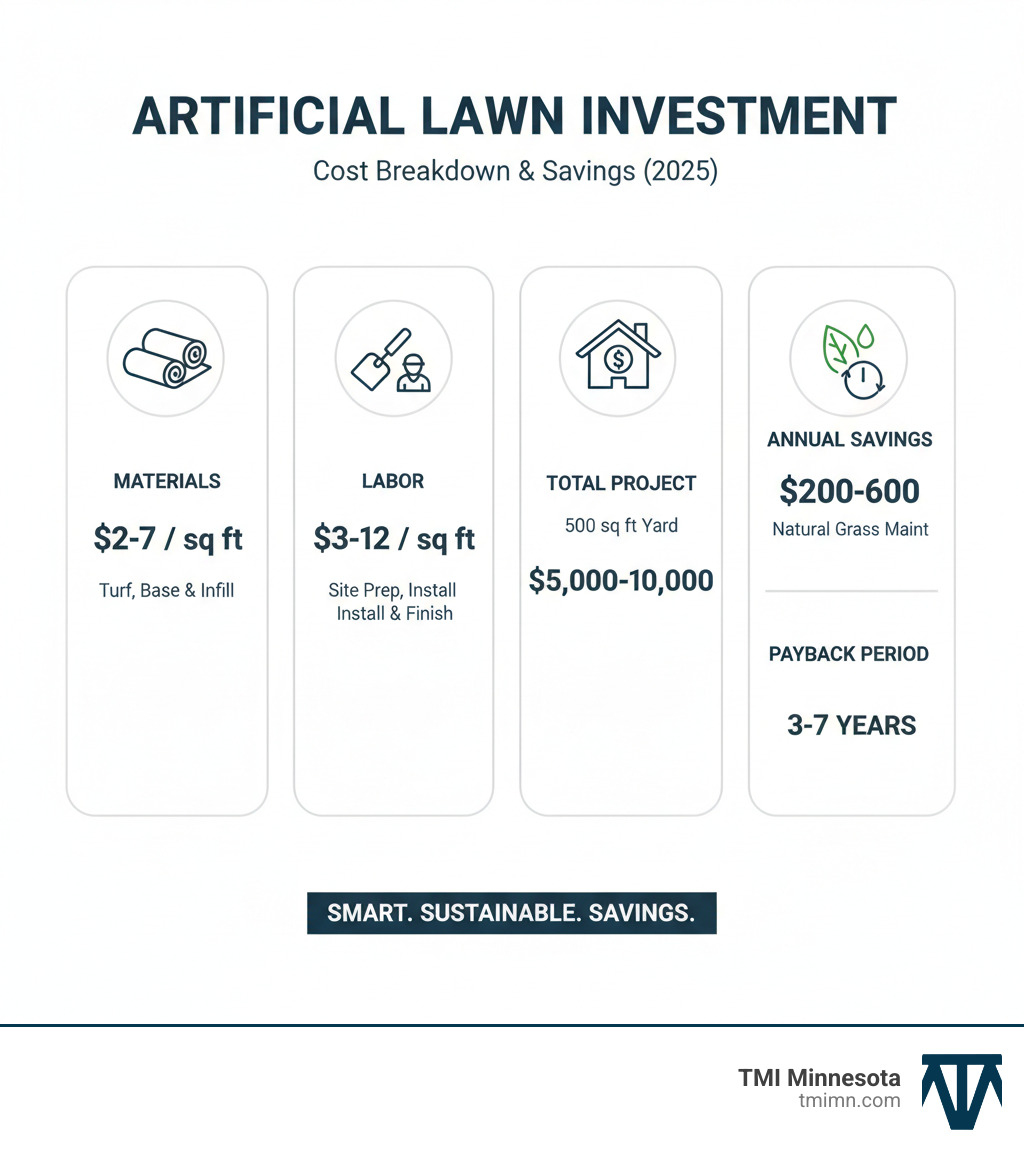
Artificial lawn cost typically ranges from $10 to $20 per square foot installed in 2025. For most homeowners, here’s what to expect:
- National Average: $10.75 per square foot
- 500 sq ft yard: $5,000 to $10,000 total
- Material only: $2 to $7 per square foot
- Labor costs: $3 to $12 per square foot
- Budget turf: $10-$12/sq ft (8-12 year lifespan)
- Premium turf: $15-$20/sq ft (15-20 year lifespan)
The upfront price tag of artificial turf can feel overwhelming. Most Minnesota homeowners investing in synthetic grass spend between $4,000 and $10,000 for an average backyard project.
However, the true value emerges over time through savings on water, fertilizer, and lawn care services. The total price depends on several factors: Material quality (budget vs. premium), installation complexity (a flat yard costs less than a sloped one), and site preparation like grass removal and drainage.
I’m Christopher Deanovic, Operations Leader at Task Masters Minnesota. I’ve helped countless Twin Cities homeowners balance quality, function, and budget for their artificial lawn projects. My team and I work daily to design outdoor spaces that deliver real value.
Artificial lawn cost glossary:
Breaking Down the Average Artificial Lawn Cost
Understanding what you’ll actually pay is the first step toward making a smart decision. The artificial lawn cost typically ranges from $6.50 to $15 per square foot across the country in 2025, with most homeowners paying around $10.75 per square foot. Premium projects or challenging installations can push that number to $19 or $20 per square foot.
For a typical 500 square foot yard, you’re looking at a total investment between $7,400 and $9,350 for mid-quality turf. While a significant upfront cost, the value is clear: a maintenance-free, year-round green lawn.
The artificial lawn cost breaks down into two main buckets: materials and labor. The turf material itself typically runs $2 to $6.40 per square foot, while professional installation labor costs anywhere from $3.45 to $12 per square foot. Labor can account for 40-60% of your total project cost, depending on yard complexity and local rates in the Twin Cities.
Budget-friendly turf ($10-$12/sq ft installed) offers an 8-12 year lifespan, while premium turf ($15-$20/sq ft installed) delivers a more realistic look and a 15-20 year lifespan with warranties.

Understanding the Artificial Lawn Cost for Materials
The turf you choose significantly impacts your budget and satisfaction. Three main synthetic fibers are used, each with a different price and characteristics.
Polypropylene is your budget-friendly option at $1.90 to $6.75 per square foot for materials. It’s best for low-traffic, decorative areas. The trade-off is a stiffer feel and lower tolerance for heat and heavy use.
Polyethylene is the Goldilocks choice for most Minnesota homeowners. At $2 to $4 per square foot for materials, it balances softness, durability, and a realistic look. It’s comfortable for bare feet, holds up to kids and pets, and looks very convincing.
Nylon is the premium option. At $5.05 to $5.83 per square foot for materials, it’s the most expensive but also the strongest. Nylon fibers are incredibly resilient, making them ideal for high-traffic areas or for those who demand top quality.
| Material Type | Cost (per sq ft, material only) | Durability | Best Use Cases |
|---|---|---|---|
| Polypropylene | $1.90 – $6.75 | Good | Low-traffic areas, decorative accents |
| Polyethylene | $2.00 – $4.00 | Very Good | Residential lawns, pet areas, moderate traffic, playgrounds |
| Nylon | $5.05 – $5.83 | Excellent | High-traffic areas, sports fields, commercial applications, putting greens |
Beyond fiber type, other material characteristics affect your artificial lawn cost. Pile height and density determine how lush and soft your lawn feels; taller, denser turf costs more. Face weight measures the weight of turf fibers, with higher weights indicating better durability and a higher price. Standard latex backing material ($1.50-$3/sq ft) works for most applications, while polyurethane backing ($3.50-$6/sq ft) offers superior drainage and durability, which is important for pets or Minnesota’s wet climate. Infill material (like silica sand or rubber) is brushed into the turf to help blades stand upright and add cushioning. This adds $0.50 to $2 per square foot.
Factoring Labor into Your Artificial Lawn Cost
The turf is only half the story; professional installation is key and a significant part of the budget. Labor costs of $3.45 to $12 per square foot reflect the skill needed for a natural-looking, long-lasting lawn.
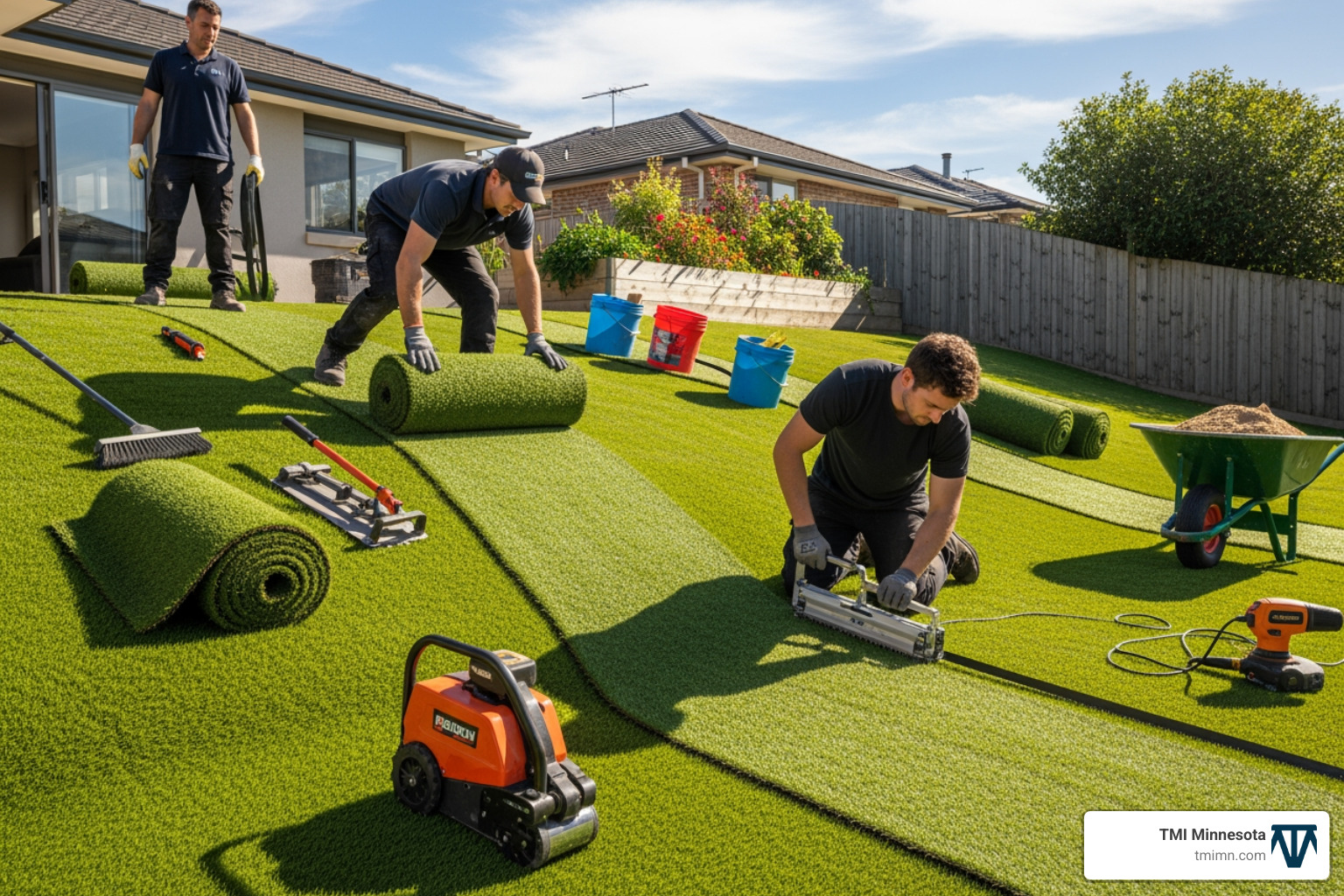
Site preparation is the heavy lifting. We remove existing grass and excavate 3-4 inches of soil for a proper foundation. Grass removal adds $0.88 to $1.84 per square foot to your project cost.
Next is grading and base compaction. We grade for drainage and compact a sub-base of crushed gravel. This stable foundation prevents settling and costs an additional $0.50-$1.50 per square foot.
Seaming and trimming require precision. Installers carefully cut and seam large turf rolls (12-15 ft wide) for a seamless look. Proper seaming is crucial to avoid a patchwork appearance.
After the turf is secured, we apply and brush in the infill to help the grass blades stand upright and feel natural.
Finally, debris removal wraps up the project. Hauling away excavated soil and debris can cost around $248 per dump truck load.
Professional installation creates a foundation that supports your lawn for 15-20 years. For more details, check out our guide on artificial grass installation.
Key Factors That Determine Your Final Price
Not all artificial lawn projects cost the same, even for identical square footage. The final artificial lawn cost depends on factors beyond materials and basic labor.
Installing turf on a flat, rectangular yard is straightforward. Adding curves, slopes, or unique features increases complexity and cost.
Installation complexity is a major price driver. Yards with curves around garden beds or trees require more precision cutting, seaming, and create material waste. For these intricate shapes, expect the installation cost to increase by 15% to 20%. A sloped installation is more challenging, requiring specialized techniques to secure the turf and prevent infill migration. This can increase your total project cost by 50% to 60%.
Project size also matters. Very small installations can have a higher per-square-foot cost due to fixed overhead. Larger projects may benefit from some economies of scale, though the total investment is higher.
Regional price differences play a role. In the Twin Cities, labor rates, material availability, and permit requirements affect your estimate. Installed turf in the Midwest typically runs $9 to $15 per square foot. We provide transparent pricing that reflects our quality work.
Site Preparation and Location Complexity
The condition of your existing landscape directly impacts your artificial lawn cost. During our consultation, we assess what’s needed to prepare your space.
If you have natural grass, we remove it and its root system, which costs between $0.88 and $1.84 per square foot. We also excavate 3 to 4 inches of soil for the new base layer.
A proper sub-base installation is critical in Minnesota’s climate. We install and compact crushed stone to create a stable, permeable foundation that prevents low spots and drainage issues. This base material adds $0.50 to $1.50 per square foot.
Some properties with low spots or heavy clay soil may need additional drainage systems. Basic systems add about $2 to $3 per square foot, while complex solutions like French drains can run $6 to $8 per square foot.
Landscape edging prevents turf edges from lifting and creates a clean transition to other areas. Depending on the material, edging costs between $2 and $11.50 per linear foot. We love combining turf and hardscapes to create beautiful, functional spaces.
Location challenges like sloped terrain, rooftops, and balconies are more complex, averaging $15 to $25 per square foot. Slopes require techniques to prevent shifting, while rooftops need special attention to weight and drainage. We’ve completed many artificial grass for rooftops projects in the Twin Cities. Irregularly shaped yards also require more precise cutting and seaming, which can add 15% to 20% to the installation cost but results in a beautiful, custom fit.
Additional Features and Customizations
Optional features can optimize your lawn for your lifestyle. While they impact the artificial lawn cost, they often add significant long-term value.
A weed barrier fabric ($0.20 to $0.75 per square foot) is inexpensive insurance against weeds.
For families with children, shock pads for playgrounds add extra cushioning for safer play. They typically add $1 to $2 per square foot, but the peace of mind is priceless.
Pet-specific turf systems feature improved drainage, antimicrobial infills, and durable backing to handle the challenges of pets. We have extensive experience creating dog friendly yard designs.
Advanced UV protection helps prevent fading and extends turf life in sunny areas, adding 10% to 15% to the material cost.
Finally, check for local permits and HOA fees. Permits can range from $50 to $300, and HOA approval fees are usually between $25 and $150. We can help you steer these requirements to keep your project on track.
Long-Term ROI: Artificial Turf vs. Natural Grass
The initial artificial lawn cost of $5,000 to $10,000 can seem high compared to sod or seed, which might only cost $2 to $8 per square foot upfront. However, a natural lawn comes with ongoing expenses.
Natural grass requires constant spending: high water bills in the summer, fertilizer, weed and pest control, and lawnmower maintenance. Professional care alone can cost $1,500 to $6,000 annually.
In contrast, artificial turf maintenance is only about $250 to $350 per year. Our clients find their lawns pay for themselves within three to seven years through these savings.
With artificial turf, your water bill will drop significantly, saving homeowners $200 to $600 per year.
You can also eliminate your lawn equipment—mower, trimmer, edger, and blower—along with the associated costs of fuel, maintenance, and replacement. Any professional mowing expenses vanish completely.
Your lawn care chemical collection can go too. You’ll no longer need fertilizers, pesticides, or herbicides. This saves money and creates a safer yard for kids and pets, giving you peace of mind.
But the most valuable saving is your time. Instead of spending weekends mowing and weeding, you can enjoy your yard. For busy families, that time savings is priceless.
The lifespan of quality artificial turf is impressive. Premium products last 15 to 25 years, often with a warranty. Unlike natural grass, which requires constant upkeep, your artificial lawn will look great year-round through Minnesota’s harsh seasons.
Over a decade, the math is clear. The upfront investment in artificial turf buys you a beautiful lawn, freedom from endless maintenance, lower utility bills, and more time to spend with family and friends.
Want to keep your turf looking its best for decades? Check out our artificial grass maintenance complete guide for simple tips.
Frequently Asked Questions about Artificial Turf Costs
We hear similar questions all the time from homeowners exploring whether artificial turf is right for their Twin Cities yard. Let’s tackle the big ones head-on.
How long does artificial turf last?
High-quality artificial turf typically lasts 15 to 20 years with proper care, and some premium products can last over 25 years. Budget-friendly options may last 8 to 12 years, while premium turf made from polyethylene or nylon can reach a 15 to 20-year lifespan with proper care.
Lifespan depends on material quality, foot traffic, professional installation, and regular maintenance. Most reputable products include an 8 to 15-year warranty against defects and UV degradation. We’ll help you understand the coverage for your investment.
Is artificial grass worth the investment?
For most Minnesota homeowners, the answer is a resounding yes. While the initial artificial lawn cost is higher, you stop paying for lawn service, water, fertilizer, and equipment. Most homeowners find their turf pays for itself within 3 to 7 years.
A perfect, year-round green lawn boosts curb appeal and property value. As thousands of homeowners are making the switch, eco-conscious buyers also appreciate low-maintenance, water-conserving landscapes.
Water conservation is another key benefit, as you dramatically reduce your household’s water consumption.
The best part is the lifestyle change. No more mowing, muddy paws, or brown patches. You get a beautiful outdoor space that’s always ready to enjoy.
What are the ongoing maintenance costs for artificial turf?
While not zero-maintenance, upkeep is minimal compared to natural grass, costing roughly $250 to $350 per year.
Brushing high-traffic areas with a stiff brush keeps blades fluffed. Hiring this service costs about $165 annually, but it’s an easy DIY task.
Occasional rinsing to wash away dust and pollen adds $0 to $100 to your annual water bill.
Every few years, you may need to replenish the infill, which costs about $85 per treatment to maintain cushioning and blade support.
For pets, remove solid waste promptly and use a pet-friendly cleaner ($40-$80 annually) to prevent odors. Deodorizing treatments may add another $60-$100.
Finally, you’ll still need to remove leaves and debris. A leaf blower or rake works well. Professional removal costs $165 to $485 seasonally. For more details, check out our artificial grass maintenance complete guide.
The bottom line? Maintenance is minimal, costs are low, and you get your time back to enjoy your yard.
Conclusion: A Smart Investment for Your Minnesota Home
While the initial artificial lawn cost can seem significant, it’s an investment that pays you back for years. The upfront price depends on material quality, installation complexity, and proper site preparation—all key to a flawless, long-lasting lawn.
Once installed, the endless cycle of mowing, watering, and fertilizing ends. Your water bills drop, your weekends are free, and your yard stays green through every Minnesota season.
The environmental benefits are also significant. You’ll conserve thousands of gallons of water annually and eliminate harmful pesticides and fertilizers, a choice that’s good for your wallet and our Minnesota environment.
Our team at TMI Minnesota receives consistently positive feedback. Clients love reclaiming their time, the year-round beauty of their yards, and the long-term value of their investment.
We use leading-edge products and installation techniques suited for the Minnesota climate, ensuring your lawn performs beautifully through heavy rains, summer heat, and freeze-thaw cycles.
If you’re ready to stop fighting with your natural grass and start enjoying a stunning, low-maintenance yard, we’d love to help you explore your options. Transform your yard with ForeverTurf and find what thousands of homeowners already know: the best time to invest in artificial turf was yesterday. The second best time is today.