
Why Artificial Turf Between Driveway Pavers Is Changing Modern Landscapes
Artificial turf between driveway pavers offers a stunning, low-maintenance alternative to traditional options like gravel or natural grass. This combination creates a clean, contemporary look that is both functional and stylish, solving the common problem of difficult-to-maintain spaces while boosting curb appeal.
Key Benefits:
- Zero maintenance: No mowing, watering, or weeding.
- Year-round green: Stays lush in any season.
- 15-20 year lifespan: Durable and UV-resistant.
- Better drainage: Permeable backing prevents pooling water.
- Modern aesthetic: Softens hardscapes and adds visual interest.
If you’re tired of battling weeds or patchy grass in the narrow gaps between your pavers, you’re not alone. The combination of pavers and artificial turf delivers lasting results, whether you’re designing a ribbon driveway, a checkerboard pattern, or simply filling existing gaps.
At TMI Minnesota, we’ve helped countless Twin Cities homeowners transform their outdoor spaces with expert artificial turf between driveway pavers installations. Our team’s hands-on experience shows how this pairing creates beautiful, practical driveways that stand the test of time.
In this guide, we’ll cover everything from design and material selection to installation and common mistakes, helping you achieve a professional look.

Why Choose Artificial Turf Between Driveway Pavers?
When considering what to put between driveway pavers, traditional options like sand or natural grass often come to mind. However, artificial turf between driveway pavers offers a superior solution that improves aesthetics while reducing your workload. It’s a choice that addresses both the desire for a beautiful driveway and the reality of not wanting to spend weekends maintaining it.
Unbeatable Aesthetics and Functionality
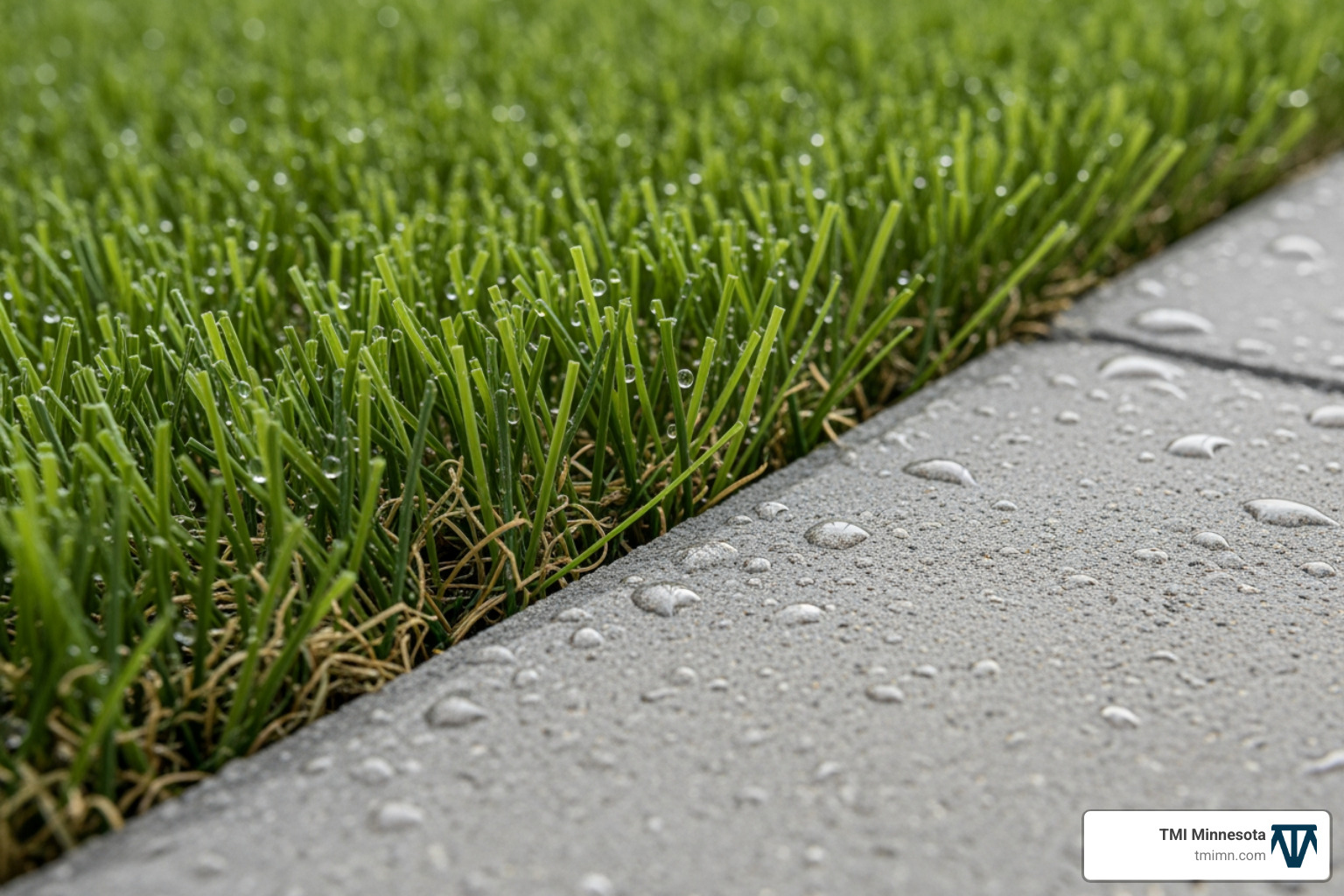
The most immediate benefit is a gorgeous, vibrant green that lasts all year. Natural grass struggles in the narrow, often shaded gaps between pavers, especially through harsh Minnesota winters. Artificial turf between driveway pavers remains consistently lush, creating a beautiful visual contrast between the crisp paver edges and the soft turf. This softens the entire hardscape, making your driveway look intentionally designed. As a modern design trend, it significantly improves curb appeal.
Functionally, artificial turf provides a less slippery surface than natural grass, which is a key advantage in our unpredictable weather. The cushioned feel underfoot is also a pleasant change from hard pavers, making your outdoor space more enjoyable to use daily.
The Low-Maintenance, High-Durability Advantage
Forget the constant battle with weeds and the awkward task of mowing or watering tiny strips of grass. Artificial turf between driveway pavers eliminates this work entirely: zero mowing, watering, weeding, or fertilizing. This low-maintenance solution gives you back your weekends.
Quality artificial turf is also built to last, with a lifespan of 15 to 20 years. It’s UV-resistant, so the color won’t fade, and it handles wear and tear without breaking down. For pet owners, it’s easy to clean and stays looking fresh. Our Artificial Grass Maintenance Complete Guide shows just how simple upkeep is.
Cost-Effectiveness Over the Long Term
While the upfront cost for artificial turf between driveway pavers is higher than gravel or seed, the long-term savings are significant. Artificial grass often pays for itself within five years by eliminating ongoing maintenance costs like water, fertilizers, and lawn equipment. In the Twin Cities, where water conservation is important, this alone can lead to substantial savings.
When you spread the initial investment over a 15-20 year lifespan, the annual cost becomes highly competitive. This type of landscaping investment also adds real value to your property, catching the eye of potential buyers. Our Hardscape Installation Cost guide explains how these investments translate into property value.
| Feature | Artificial Turf Between Pavers | Natural Grass Between Pavers | Loose-Fill (Gravel/Mulch) |
|---|---|---|---|
| Annual Maintenance | Very Low (sweeping/rinsing) | High (mowing, watering, weeding, fertilizing) | Moderate (weed pulling, replenishment) |
| Water Usage | None | High | None |
| Weed Control | Minimal | Constant battle | Frequent |
| Lifespan | 15-20+ years | Seasonal/Ongoing | 2-5 years (replenishment) |
| Appearance | Consistent Green, Lush | Varies (seasonal, patchy) | Static, can shift |
| Drainage | Excellent (permeable backing) | Good (can puddle) | Excellent |
| Safety | Less slippery, cushioned | Can be slippery | Can be uneven, trip hazard |
| Initial Cost | Higher | Lower | Lowest |
| Long-Term Cost-Effectiveness | Excellent (low maintenance) | Poor (high maintenance) | Moderate (ongoing replenishment) |
Designing Your Driveway with Turf and Pavers
The beauty of integrating artificial turf between driveway pavers lies in the endless design possibilities. This combination allows for unique outdoor spaces that reflect your style and complement your home’s architecture, whether it’s traditional or modern.

Popular Design Patterns and Ideas
You can go far beyond simply filling gaps to create genuine visual interest.
- The ribbon driveway is a timeless choice, featuring two paver strips with turf in the middle, creating clean wheel tracks with a green appearance. You can find examples in our collection of driveway designs pictures.
- A checkerboard pattern, with alternating squares of pavers and turf, makes a bold, modern statement.
- Linear strips of turf between rectangular pavers offer a minimalist look that is neat and functional.
- For a unique touch, consider mixing different paver sizes or exploring other geometric layouts like diamonds or chevrons. You can see creative combinations in our gallery.
For most designs, the ideal gap width between pavers is around 4 inches. This provides the best balance of aesthetic appeal, installation ease, and structural integrity for vehicle traffic.
Choosing the Right Pavers and Turf for Your Project
Selecting quality materials is crucial for the success and longevity of your artificial turf between driveway pavers project.
For pavers, concrete pavers are a versatile and popular choice. We also highly recommend porcelain pavers (2CM or 3/4 inch thick) for driveways due to their superior durability. They resist fading, staining, and mold, and they handle Minnesota’s freeze-thaw cycles exceptionally well without sealant. For a more rustic look, natural stone pavers like granite can be used, but ensure they are thick enough to support vehicle weight.
For stability and drainage, we often guide clients toward permeable paver driveways or interlocking paver driveways, which both pair perfectly with artificial turf.
When selecting the turf, consider these factors:
- Pile Height: A shorter pile of around 1 to 1.5 inches is best for driveways, as it’s easier to maintain and stands up better to traffic.
- Density and Face Weight: Higher density means more resilient turf that won’t flatten easily.
- Backing: The turf must have a permeable backing for proper drainage. This is non-negotiable for preventing water pooling and ice formation.
How to Install Artificial Turf Between Driveway Pavers: A Step-by-Step Guide
Installing artificial turf between driveway pavers is a manageable project with the right approach. This guide distills our professional process into clear steps for a long-lasting installation.

Step 1: Base Preparation and Drainage
A solid base is the key to a 20-year installation versus a 2-year one. This step is critical in Minnesota’s climate.
- Excavate: Remove 3-4 inches of soil to make room for the base layer.
- Add Sub-Base: Spread a 3-inch layer of crushed rock or decomposed granite. This permeable layer is essential for drainage.
- Compact: Thoroughly compact the sub-base using a stamp compactor. A firm, stable foundation prevents shifting and is the most common point of failure in DIY projects.
- Grade: Ensure the area has a slight slope (1-2%) away from your home to direct water runoff.
- Add Weed Barrier: Lay down weed barrier fabric over the compacted base for extra protection against persistent weeds.
For existing concrete surfaces, ensure drainage by drilling holes if water tends to pool. For more on this phase, see these Critical Steps for Installing Artificial Turf Between Pavers.
Step 2: Cutting and Placing the Artificial Turf
Precision is key to a professional look. First, unroll the turf and let it sit in the sun for 1-2 hours to make it more pliable.
Measure each gap carefully—measure twice, cut once. Always cut from the backing side with a sharp utility knife, following the stitching rows to avoid shedding blades. We recommend leaving an extra 1-2 inches on each side for final trimming. For blade direction, ensure all strips face the same way for a uniform, natural appearance.
Step 3: Securing the Turf Strips
To secure the turf, your method will depend on the base.
- Over a prepared base: Use non-galvanized landscape nails every 3-6 inches along the edges. Drive them down so they are level with the turf backing, then fluff the fibers around them to hide the nail heads.
- Over concrete: Use a strong, outdoor-grade turf adhesive along the paver edges. Press the turf firmly into the glue and allow it to cure for about 2 hours. Leave a tiny 1/8-inch gap between the turf and paver, which the blades will naturally cover.
For joining multiple pieces, use seam tape and adhesive to create an invisible connection.
Step 4: Applying Infill and Final Brushing
Infill provides stability, helps the blades stand upright, and aids in drainage. Silica sand is a common and effective choice.
Apply the infill at a rate of 1-2 pounds per square foot. A garden trowel offers good control for spreading it evenly in narrow gaps.
Finally, use a power broom or stiff-bristled brush to work the infill down into the fibers. Cross-brushing—brushing both with and against the grain—is the best technique to make the fibers stand up for a lush, full look. This final step brings your installation to life.
Key Considerations and Common Mistakes to Avoid
While artificial turf between driveway pavers is a superior solution, a successful project requires careful planning. Here are some key lessons we’ve learned from years of installations in Minnesota.
Driving and Parking on Your Turf and Paver Driveway
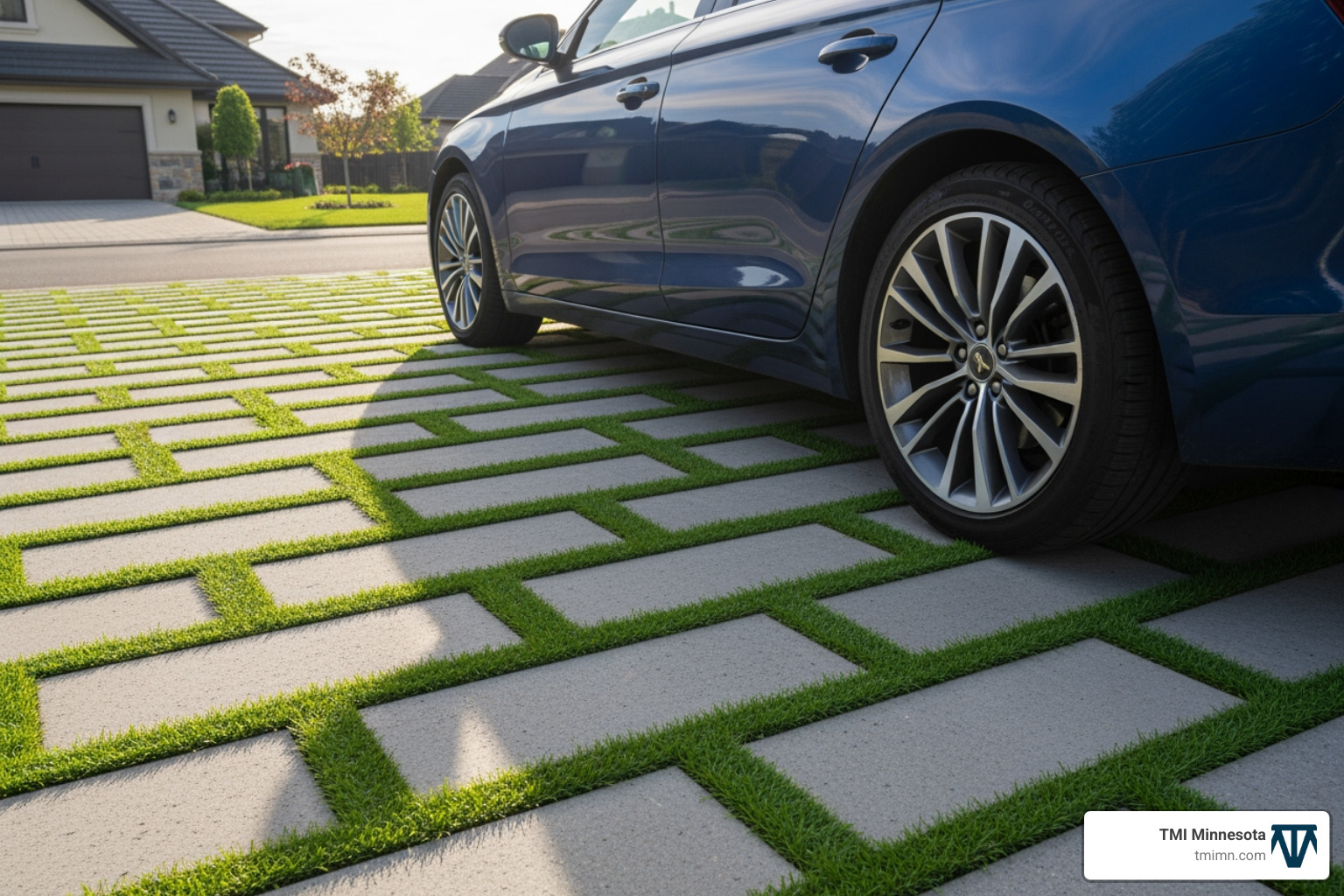
Can you drive on artificial turf between driveway pavers? Yes, but with an important rule: your vehicle’s tires should always rest on the pavers, not the turf. Pavers are the load-bearing elements designed to handle the weight of a vehicle, which can be over 4,000 pounds.
Parking directly on the turf for long periods will compress the fibers. While they can bounce back, repeated compression will shorten the turf’s lifespan. Ensure your pavers are thick enough and properly installed to support vehicles without cracking. Also, be mindful of vehicle fluid leaks, as oil and gasoline can stain the turf. If a spill occurs, clean it promptly. Our guide on How to Remove Oil From Block Paving Driveway offers helpful tips.
Top Installation Mistakes and How to Prevent Them
Many common installation errors are preventable with attention to detail. Avoid these pitfalls:
- Poor Drainage: This is the most serious mistake. Without a properly graded, permeable sub-base, you’ll get pooling water, odors, and shifting pavers. On concrete, drainage holes are essential.
- Inadequate Base Compaction: An uncompacted base will settle unevenly, creating dips and bumps. Take the time to compact the sub-base thoroughly, even in narrow gaps.
- Choosing the Wrong Turf: Using a low-density turf meant for decorative areas will lead to premature wear. Select a durable turf with a pile height around 1-1.5 inches designed for landscape use.
- Visible Seams: This amateur mistake ruins the natural look. Always align the blade direction on all strips and use proper seaming techniques to make joints invisible.
- Insufficient Infill: Skimping on infill leaves turf looking flat and unnatural. It’s crucial for blade support, stability, and drainage. Apply 1-2 pounds per square foot and brush it in thoroughly.
Frequently Asked Questions
Homeowners in the Twin Cities often have great questions about artificial turf between driveway pavers. Here are answers to the most common ones.
How long does artificial turf between pavers last?
With quality materials and professional installation, you can expect your artificial turf between driveway pavers to last 15-20 years or more. The key factors influencing lifespan are the quality of the turf product (look for UV resistance and durable backing), the quality of the installation (especially base preparation and drainage), and the amount of traffic it receives. Many reputable manufacturers offer 10-15 year warranties for peace of mind.
What is the best spacing between pavers for artificial turf?
We’ve found that 4 inches is the ideal spacing between pavers. This width provides a great aesthetic balance, allowing the green turf to contrast beautifully with the pavers without overwhelming them. It’s also a practical width that makes cutting and securing the turf strips straightforward while maintaining the structural integrity of the driveway.
Can I install artificial turf between pavers myself?
Yes, installing artificial turf between driveway pavers can be a DIY project for those with landscaping experience. The steps are logical, but success lies in the details.
However, challenges like ensuring proper drainage, achieving thorough base compaction in narrow gaps, and cutting turf for invisible seams often require specialized tools and expertise. A professional installation guarantees these critical steps are done correctly, protecting your investment and delivering a flawless finish that lasts. If you want guaranteed results without the steep learning curve, hiring a professional is often the smarter long-term choice.
Lift Your Driveway with a Professional Touch
Integrating artificial turf between driveway pavers is a smart investment in your home’s curb appeal, functionality, and long-term value. It creates a professionally designed look that stays green year-round with virtually no maintenance. No more battling weeds or patchy grass—just a beautiful, welcoming entrance to your home.
The clean contrast between structured pavers and lush turf creates a modern aesthetic that lifts any property. It’s the perfect fusion of hardscape and softscape elements.
At TMI Minnesota, our team has years of hands-on experience with both artificial turf and paver installations. We understand the critical details—from proper drainage for Minnesota’s climate to precise cuts for a seamless finish—that ensure a great result that lasts for decades. Whether you envision a ribbon driveway or a bold checkerboard pattern, we use leading-edge products to turn your vision into a durable, stunning reality.
Once installed, you can simply enjoy it. No watering, mowing, or fertilizing—just a perfect green driveway that welcomes you home every day.
Ready to transform your driveway? Learn more about our artificial turf and paver solutions and find how we can create a driveway that’s not just functional, but truly exceptional.