
Transform Your Evenings with Strategic Outdoor Illumination
Need a reason to stay outside after sunset? Thoughtful backyard garden lighting ideas turn decks, patios, and flower beds into inviting night-time retreats. A well-layered plan delivers ambiance, safety, and a healthy boost to curb appeal—all while sipping just a fraction of the energy older bulbs demanded.
Quick fixes you can tackle this weekend:
- Pathways: Solar or low-voltage LEDs every 6-8 ft
- Dining Zones: Warm-white (≈2700 K) string or pendant lights
- Garden Highlights: Uplight a tree, downlight a pergola
- Security: 1400+ lumen motion floods at key entry points
- Atmosphere: Mix overhead, mid-level, and ground lights for depth
Modern LEDs use up to 75 % less energy than incandescent options and last for years. That means fewer bulb changes and lower bills.
I’m Christopher Deanovic, Operations Leader at Task Masters, and I’ve helped Twin Cities homeowners shape landscapes that shine—literally.
Why Garden Lighting Is a Game-Changer
Imagine guests lingering outside long after sunset because your yard glows with soft, flattering light. Strategic illumination marries visual appeal and safety—no more tripping on hoses in the dark.
Other perks you might not expect:
- Extended outdoor living—decks become evening dining rooms.
- Motion-sensor security that doubles as walkway safety.
- LEDs that cut energy use by up to 75 % (see the Department of Energy overview).
Common Pitfalls
- Glare bombs: fixtures aimed straight at eyes. Use shields or angle beams down.
- Over-lighting: mall-parking-lot brightness kills atmosphere.
- Wrong IP rating: Minnesota needs IP65+ to handle rain, snow, and freeze-thaw cycles.
Fixture Types & Hot Trends for 2024
The toolbox for backyard garden lighting ideas keeps expanding:
- Solar path lights: stainless, dusk-to-dawn, no wiring.
- Low-voltage copper spotlights: patina gracefully, aimable, dimmable.
- Commercial string lights: 14-gauge wire, shatter-proof Edison LEDs.
- Smart RGB floods: motion alerts + color scenes in one fixture.
- Integrated hardscape LEDs: invisible strips built into retaining walls.
Classic standbys—wall sconces, post lanterns, and deck-rail strips—remain reliable and easy on the eyes. For installation help, visit our outdoor lighting installations page.
Backyard Garden Lighting Ideas: Product Roundup
Let’s explore some real-world backyard garden lighting ideas that work beautifully in Minnesota’s climate. I’ve personally seen how the right combination of fixtures can transform an ordinary backyard into something truly magical.
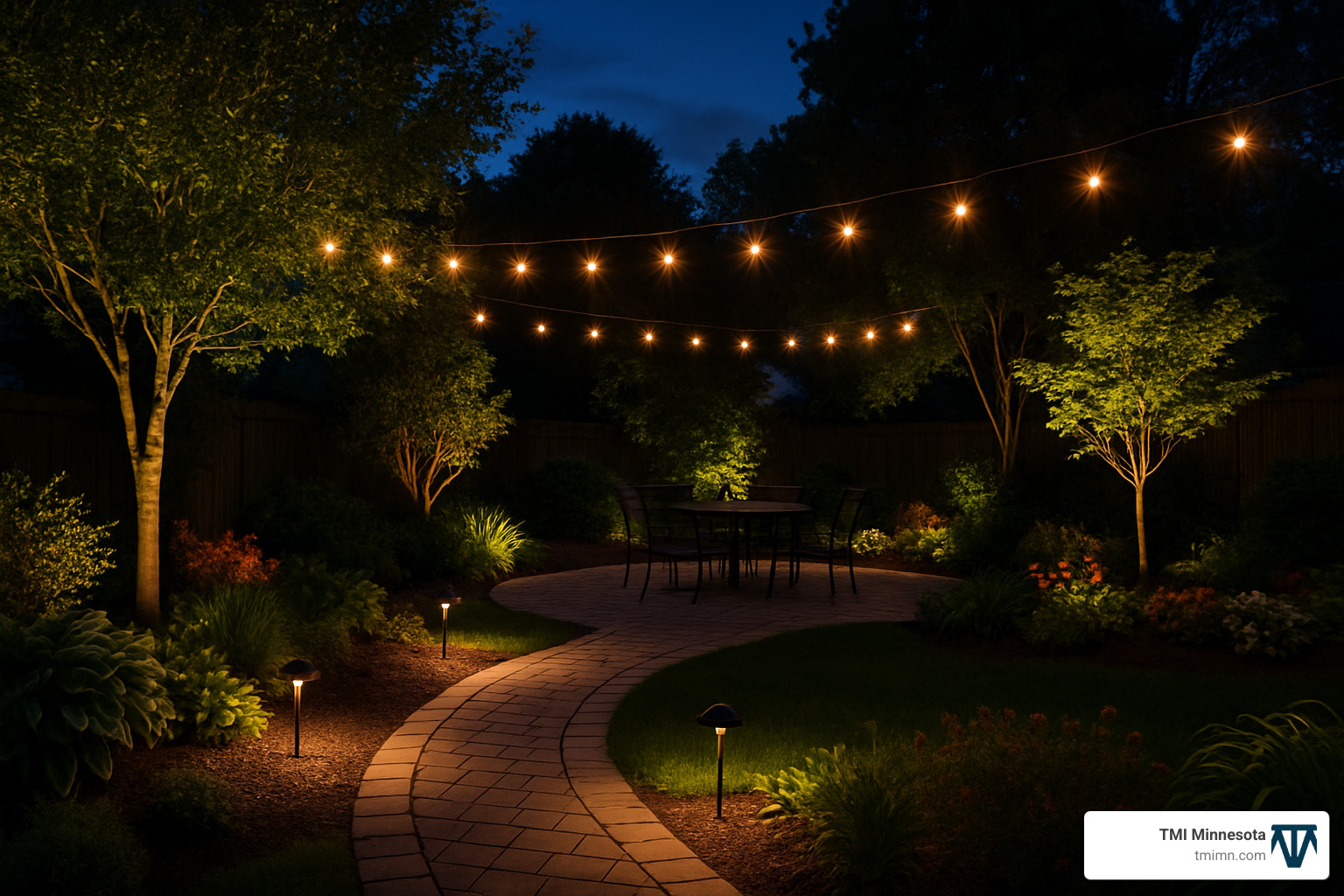
The secret to successful outdoor lighting isn’t using one type of fixture everywhere. Instead, think about accent lighting that highlights your favorite plants, zone planning that creates distinct areas for different activities, and mixing fixture types that work together harmoniously.
When I walk through a well-lit backyard, I notice how each fixture serves a purpose. The string lights overhead create that cozy café atmosphere everyone loves. Path lights guide you safely along walkways without being too bright or harsh. Spotlights draw your eye to that beautiful oak tree or the fountain you’re so proud of.
The key is starting with a plan. Walk through your yard at dusk and think about where you need light for safety, where you want to highlight features, and where you gather with family and friends. Each area might need a different approach, but they should all work together to create one cohesive outdoor experience.
Your lighting zones might include the main patio for entertaining, pathways for safe navigation, garden beds for showcasing plants, and perhaps a quiet corner where you like to read with your morning coffee. Each zone can have its own character while contributing to the overall ambiance of your outdoor space.
1. Solar Pathway Starter Kit
Best for: First-time installers, remote garden areas, and anyone who wants beautiful lighting without the electrical headache
If you’re looking for the easiest entry point into backyard garden lighting ideas, solar pathway kits are your new best friend. I’ve watched countless homeowners transform their landscapes in a single afternoon with these plug-and-play solutions.
The beauty of solar path lights lies in their zero-wiring simplicity. No trenching through your carefully planted beds, no electrical permits, and definitely no surprise utility line findies. You literally just stake them into the ground where you want light.
Modern solar technology has come a long way from those dim, disappointing lights of the past. Quality stainless steel fixtures now deliver 50-100 lumens per light – plenty for safe pathway navigation. The LED bulbs last over 25,000 hours, and with automatic dusk-to-dawn operation, they handle the timing so you don’t have to.
Here’s what makes today’s solar path lights actually work well: The photovoltaic panels charge during the day and can power LEDs for up to 19 hours on a full charge. That’s more than enough for our Minnesota evenings, even during shorter winter days.
Installation couldn’t be simpler. Choose spots that get at least 6 hours of direct sunlight daily – this is crucial for proper charging. Space your lights 6-8 feet apart for smooth, continuous illumination along walkways. Pro tip: Install them in early spring so the batteries get properly conditioned before winter hits.
The weather-resistant IP65 rating means these fixtures laugh at Minnesota’s mood swings. Stainless steel construction prevents the rust and corrosion that used to plague outdoor lighting.
Winter reality check: Yes, shorter daylight hours mean reduced charging time. Your lights might only run 4-6 hours instead of all night during December and January. But honestly, that covers most evening activity anyway.
For homeowners who want instant gratification with their lighting projects, solar pathway kits deliver results the same day you install them. No waiting for electricians, no permit delays – just immediate improvement to your outdoor space.
2. Low-Voltage Copper Spotlights
Best for: Mature trees, sculptures, architectural accents
Why copper? It weathers beautifully and survives decades of Minnesota winters. Pair fixtures with a dimmable 12-volt transformer, use 12-gauge direct-burial cable for long runs, and place lights 6-10 ft from the target for soft, dramatic highlights.
| Feature | Solar Path | Low-Voltage Spot |
|---|---|---|
| Install | DIY | Pro/advanced DIY |
| Lumens | 50–100 | 200–500 |
| Lifespan | 3–5 yr | 15–20 yr |
| Cost/yr | $0 | $15–30 |
With narrow 15–30° beams you’ll get pro-level silhouettes without blinding the neighbors.
3. Commercial-Grade String Lights
Best for: Dining patios, pergolas, four-season ambiance
Heavy-duty stringers plus 1-watt Edison LEDs create that instant café vibe. Support long runs with steel cable every 8–10 ft to prevent sag. Built-in dimmers let you crank brightness for meal prep, then dial back for conversation. A 25-bulb strand sips only about $10 of electricity per year—so leave them up year-round.
4. Smart RGB Flood & Security Combo
Security meets fun. These 1000–2000 lumen floods detect motion up to 50 ft, send phone alerts, and shift to party colors on command. Compatible with Alexa and Google; many models include battery backup for power outages. Light the grill station bright white, switch to warm amber for dessert—no ladder required.
5. DIY Lantern & Mason Jar Set
Battery-powered fairy LEDs in jars or lanterns cost little, look fantastic, and are 100 % kid-safe. Use timer modules so they auto-glow at dusk, then shut off to save batteries. Hang them from trees, cluster on tables, or float waterproof candles in a bowl—portable charm with zero wiring.
Small vs. Large Yards
- Compact spaces: Choose multipurpose fixtures—wall sconces + overhead strings—that free up floor area.
- Expansive lots: Light by zones. Fewer, brighter fixtures (wider beams) prevent dark gaps and trim budgets.
Layering, Placement & Safety Tips
Think three tiers:
- Ambient (8–12 ft): strings, tree-mounted downlights.
- Task (4–6 ft): sconces, grill lights.
- Accent (0–3 ft): path stakes, step lights, spot uplights.
Always use GFCI protection and bury low-voltage cable 6 in. Aim beams downward to respect neighbors and the night sky. Clean lenses monthly and check seals each fall to keep systems shining.
DIY & Budget-Friendly Hacks
- Planter-pole supports: Fill large pots with quick-set concrete to anchor string-light posts—no digging.
- PVC sleeves: Pound a sleeve into the soil, drop in a removable pole each summer.
- Rope-light railings: Clip LED rope under deck rails for subtle border lighting.
- Pallet screens: Weave string lights through pallet slats for instant privacy + glow.
For step-by-step visuals, see this external backyard lighting guide.
Frequently Asked Questions about Backyard Garden Lighting
How many lumens do I need for walkways?
The sweet spot for safe pathway navigation is 100-200 lumens per fixture, spaced about 6-8 feet apart. This gives you that perfect balance – enough light to see where you’re stepping without turning your garden into a football stadium.
If you have ambient light spilling out from your house windows or nearby street lights, you can get away with 50-100 lumens and still have perfectly safe pathways.
Pathway width matters too. That narrow stepping stone path to your herb garden doesn’t need as much illumination as your main walkway where the whole family trudges through with groceries.
Are solar lights bright enough in winter?
Solar lights definitely face some challenges during our long, dark Minnesota winters. The reduced daylight hours and snow coverage on panels can make even quality solar fixtures struggle a bit.
Expect about 4-6 hours of operation during winter months compared to the 8-12 hours you’ll get in summer. That’s usually enough for your evening activities, but don’t count on them glowing all night long in January.
The key is choosing quality solar fixtures with larger panels and lithium batteries – they handle cold weather much better than basic models. Keep those panels clear of snow accumulation.
What’s the safest way to wire low-voltage kits?
Even though low-voltage systems run on just 12 volts, you still want to do things right. Safety first, beautiful lighting second – though you can definitely have both!
Start with direct burial cable rated for outdoor use – typically 12 or 14 gauge wire for longer runs. Bury those cables at least 6 inches deep and mark the locations.
GFCI protection at the transformer location is non-negotiable, and use weatherproof wire connectors filled with dielectric grease. That little bit of grease prevents corrosion and keeps your connections solid for years.
Always check your local electrical codes, and don’t hesitate to call in a professional for complex systems.
Conclusion
A few strategic backyard garden lighting ideas can turn any Twin Cities yard into an evening destination—without spiking your utility bill. Start small with solar path stakes or a strand of café lights; layer in spotlights or smart floods as your budget allows. Need a full design or code-compliant install? TMI Minnesota is ready to help your landscape shine.