
Why Your Boulder Retaining Wall Project Demands Careful Planning
A boulder retaining wall is a structure built from large, natural stones to hold back soil. Here’s a quick overview:
- Functions: Controls erosion, creates usable outdoor space, and improves landscape aesthetics.
- Advantages: Natural beauty, exceptional durability (50-200 year lifespan), and minimal maintenance.
- Components: A solid foundation, proper drainage, interlocking boulder placement, and a slight backward lean (batter).
- Costs: Typically $40-$55 per square foot, varying with complexity.
Boulder retaining walls are engineered structures that blend art and science. Built correctly, they prevent erosion and transform sloped yards for generations. Built incorrectly, they can fail within years, leading to costly repairs. Many homeowners love the rustic look, but as one specialist warns, “Many boulder walls fail prematurely because they weren’t built correctly—often by contractors who didn’t specialize in them.”
The difference between a wall that lasts 50 years and one that fails in five comes down to three factors: proper planning, solid foundation work, and effective drainage. Skipping any of these leads to expensive problems.
Most mistakes are avoidable if you know what to watch for. I’m Christopher Deanovic, Operations Leader at Task Masters (TMI Minnesota). I’ve spent years helping homeowners build durable, beautiful landscape features, and I’ve seen what works—and what doesn’t—with boulder retaining wall projects.
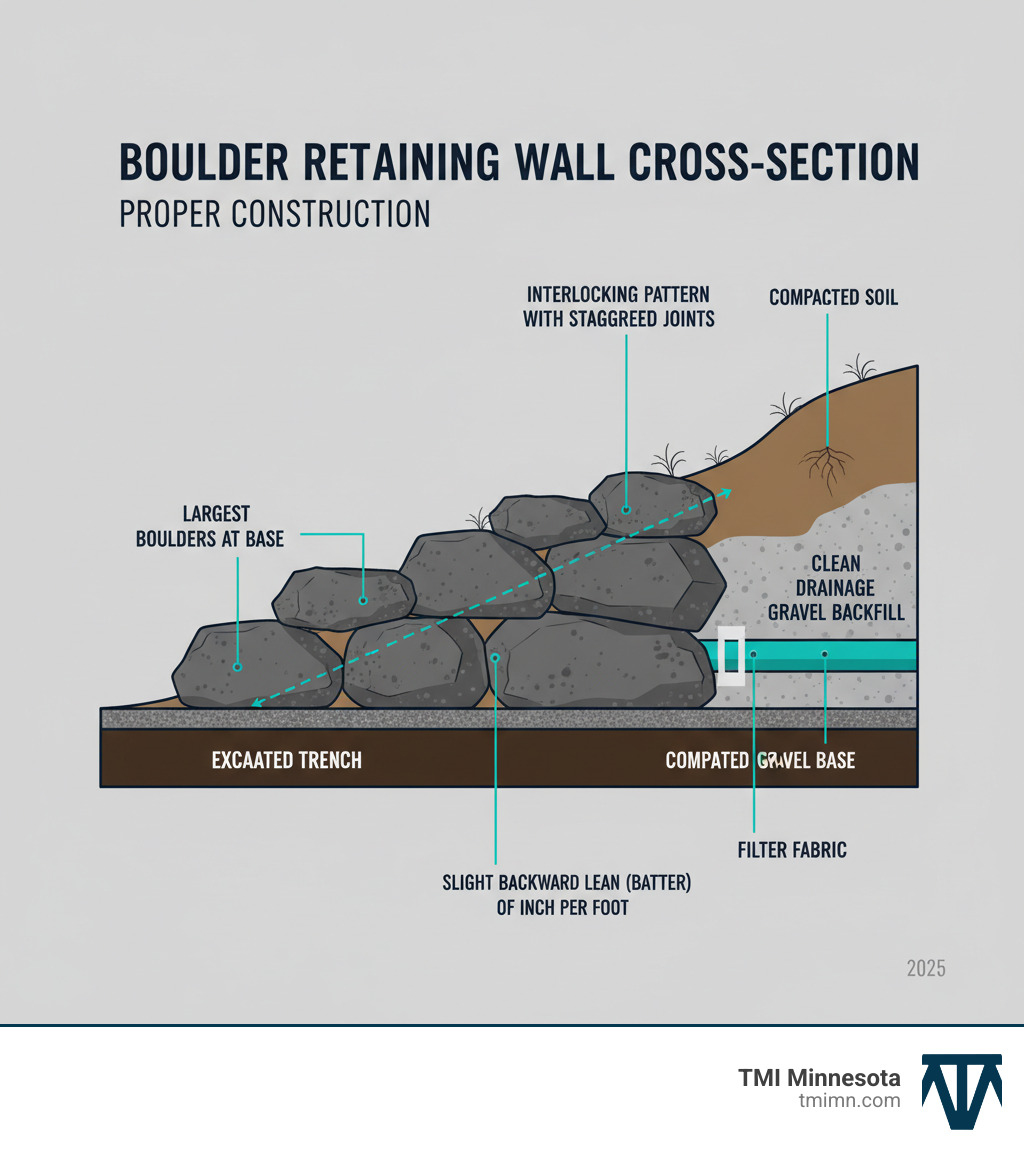
Boulder retaining wall terms simplified:
Mistake #1: Rushing the Planning and Design Phase
The most expensive mistakes in boulder retaining wall construction happen before a single stone is placed. Rushing the planning phase can lead to crumbling walls, drainage nightmares, and permit violations. This phase is where success is won or lost, as it determines the wall’s longevity and future repair needs. Our retaining wall design services guide you through these critical decisions so nothing is overlooked.

Assessing Your Property’s Unique Needs
No two yards are alike, so a thorough property assessment is essential.
- Soil type is critical. Sandy soils drain well but can erode, while clay soils retain water, creating immense pressure. We test your soil to design accordingly.
- The terrain and slope determine the wall’s height and if engineering is needed. A gentle slope is straightforward, but a steep drop requires permits and professional calculations to prevent failure.
- Existing drainage patterns show where water flows during heavy rain. We design the wall to work with this flow, not against it, preventing dangerous pressure buildup.
- Space availability dictates what’s possible, such as whether an excavator can access the site. For Minnesota landscapes, we also consider freeze-thaw cycles.
This assessment is the foundation of our eco-friendly landscape design, creating walls that solve problems and improve your property.
Choosing the Right Boulders for Your Retaining Wall
Picking the right boulders affects stability, ease of stacking, and appearance.
- Fieldstone offers a classic, weathered look. Its irregular shapes require more skill to stack securely but blend beautifully into natural settings.
- Quarry boulders have angular shapes and flatter faces, making them easier to stack and interlock. They look newer initially but weather over time.
- River-washed boulders are smooth and rounded, creating a polished look. Their shape can make stable stacking more challenging.
Beyond type, we prioritize size and weight. The largest, flattest boulders form the base for stability. We also look for shapes that interlock like a puzzle to prevent shifting. Finally, the color and texture should complement your home and landscape. You can create a cohesive look by extending these materials to other features, like a natural stone driveway. For more on stone types, the Stone Wikipedia article is a useful resource.
Calculating Materials and Navigating Permits
Accurate calculations prevent frustrating and expensive material shortages or overages. We calculate the required volume (length x height x thickness), with a wall’s thickness being about half to two-thirds its height. We add 15-20% extra to account for gaps and unusable stones. Boulders are sold by the ton ($100-$350/ton, up to $600/ton for premium stones), so we convert volume to tonnage for an accurate cost estimate.
Overlooking permit requirements can lead to demolition orders.
- Walls over four feet almost always require permits and professional engineering to ensure they can handle the immense soil pressure.
- Local building codes in the Twin Cities specify height limits, property line setbacks, and drainage rules.
- Engineering needs arise for walls supporting heavy loads (like a driveway) or on difficult terrain. A structural engineer designs these walls to handle specific forces.
We handle the permit process to ensure your project is compliant from the start.
Mistake #2: Skimping on Foundation and Drainage
The foundation and drainage system are unseen but essential for your boulder retaining wall’s longevity. Cutting corners here to save time or money is a primary cause of wall failure. What’s underneath and behind your wall is just as important as the visible boulders.

How to Properly Prepare the Site and Set the Base
A strong boulder retaining wall needs a solid foundation. Proper preparation prevents leaning and shifting. Essential tools include an excavator, shovels, a plate compactor, and levels. You’ll also need landscape fabric, crushed gravel, perforated drainage pipe, and clean drainage gravel. Always wear safety gear like gloves, safety glasses, and steel-toed boots.
Site preparation involves these steps:
- Excavate a level trench wide enough for your largest boulders and deep enough for proper embedment (burying the first course).
- Lay heavy-duty landscape fabric in the trench and up the back slope to prevent soil from clogging your gravel base.
- Add 4-6 inches of crushed gravel in 2-inch layers (lifts), compacting each lift thoroughly with a plate compactor.
- Level the base perfectly. Any inconsistencies here will be magnified as the wall gets taller.
For walls over 4 feet, a concrete footer may be required by engineering plans for additional support.
The Critical Role of Drainage in a Boulder Retaining Wall
Water is your wall’s biggest enemy. Hydrostatic pressure—the force of water building up behind a wall—can push out even the heaviest stones. A multi-part drainage system is crucial to prevent this.
- Geotextile fabric lines the trench, letting water pass through while blocking soil particles that could clog the system.
- A 4-inch perforated drainage pipe (or French drain) is installed behind the first course of boulders. It collects water and directs it away from the wall.
- At least 12 inches of clean, washed drainage gravel is placed around the pipe and behind the wall as it’s built. This creates a permeable zone for water to flow freely to the pipe.
In soils with high clay content, filter fabric can sometimes clog. In these cases, planting vegetation in the joints can help stabilize the soil and prevent it from weeping through. We follow industry standards, like those in the Allan Block Best Practices for retaining wall construction, and integrate our work with broader landscape irrigation solutions for total property health. A proper foundation and drainage system are your best insurance for a long-lasting wall.
Mistake #3: Improper Stacking and Construction
This is where skill and experience are most visible. Building a boulder retaining wall is not just moving heavy rocks; it’s about strategic placement to create an interlocked system. Poor placement is a common cause of failure, and working with multi-ton boulders makes safety paramount.

The Step-by-Step Process for Building the Wall
With the foundation ready, the methodical process of building the wall begins.
- Place the base course. We select the largest, flattest boulders and set them on the compacted gravel base. The key is to place the bulk of the stone’s mass into the bank, not just showing a large face. This creates depth and resistance.
- Interlock subsequent layers. We stagger the joints on each new course, similar to laying bricks. This distributes weight and pressure evenly, avoiding weak vertical seams.
- Create a “batter.” A professional wall includes a slight backward lean into the slope, about one inch of setback for every vertical foot. This uses gravity to help resist soil pressure.
- Fill gaps. We fill voids between irregular boulders with smaller stones or gravel to keep the wall solid and prevent soil from washing through.
- Backfill in lifts. As each course is laid, we immediately backfill behind it with drainage gravel and then compacted soil, working in 4-6 inch layers. This provides continuous support as the wall rises.
This process requires an understanding of how soil, water, and gravity interact, which is why it’s a core part of our hardscape installations expertise.
Crucial Safety Precautions During Construction
Working with heavy boulders and machinery is dangerous. We take every precaution to protect our team and your property.
- Heavy Machinery Safety: Our operators are certified and experienced, following strict protocols and maintaining clear communication on-site.
- Personal Protective Equipment (PPE): Hard hats, steel-toed boots, heavy-duty gloves, and eye protection are mandatory. As one crew member says, “Heavy stones around is not a flip-flop-friendly activity!”
- Stable Operation: All equipment must operate on stable, level ground to prevent tipping.
- Safe Distances: We enforce a strict rule: never work under suspended loads. No one stands beneath a suspended boulder or directly behind moving equipment.
- Secure Placement: Every boulder is checked to ensure it is firmly seated and stable before moving on.
Understanding the Costs, Comparisons, and Long-Term Value
When considering a boulder retaining wall, it’s important to understand the upfront cost, how it compares to other options, and its long-term value. For a broader financial overview, see our guide on hardscape installation cost.
Breaking Down the Cost of a Boulder Wall
While not the cheapest option, the incredible lifespan of boulder retaining walls often makes them the most economical choice over time.
- Average Cost: Expect to pay $40 to $55 per square foot or $50 to $200 per linear foot. Complex projects can reach $200+ per square foot.
- Total Project Cost: Most projects fall between $2,000 and $10,000. Larger or engineered walls can range from $10,000 to $40,000 or more.
Key cost drivers include wall size, boulder type ($100-$600+ per ton), site accessibility, and labor costs ($10-$60 per square foot). Complex site conditions or the need for sophisticated drainage systems also affect the final price. Skimping on drainage to save money upfront will cost you thousands in repairs later.
How Boulder Walls Compare to Other Options
Here’s how boulder retaining walls stack up against other common choices:
- Block Walls: ($15-$30/sq. ft.) The most budget-friendly option with a clean look. Lifespan is 30-70 years with moderate maintenance.
- Gabion Walls: ($10-$40/sq. ft.) Metal cages filled with rocks, great for shifting soils. Lifespan is 50-100 years with an industrial aesthetic.
- Dry-Stack Stone Walls: ($20-$85/sq. ft.) Similar natural beauty to boulder walls, with a 50-100+ year lifespan. Requires more skilled labor.
- Stone Veneer Walls: ($30-$80/sq. ft.) A stone façade over a structural wall. Offers a polished look but the veneer only lasts 20-50 years.
Boulder retaining walls ($40-$55/sq. ft.) are a mid-to-upper range investment, but their 50-200 year lifespan with minimal maintenance provides exceptional long-term value. Their natural aesthetic is timeless, making the initial cost a worthwhile investment over decades.
Lifespan and Maintenance Best Practices
A properly built boulder retaining wall can last 50 to 200 years. Boulders endure weather and time far better than concrete, brick, or metal.
Maintenance is minimal. We recommend a regular visual inspection a few times a year, especially after heavy rain or harsh Minnesota winters. Look for shifting boulders or signs of erosion. If you see soil washing through the wall or water pooling at the base, it may indicate a drainage issue that needs a simple fix.
Managing vegetation is mostly for aesthetics. Shallow-rooted plants can improve the wall’s beauty and help stabilize soil. Avoid deep-rooted trees nearby that could disrupt the structure. With minimal attention, your wall will protect and improve your property for generations.
Frequently Asked Questions about Boulder Retaining Walls
We get many questions from homeowners about boulder retaining walls. Here are answers to the most common ones.
When is it necessary to hire a professional instead of DIY?
While a small, decorative wall under 2-3 feet might be a DIY project for a capable homeowner, most situations demand professional expertise. You should always hire a pro for:
- Walls over 4 feet high: These require permits and professional engineering due to the immense physical forces involved.
- Complex slopes or unstable terrain: These require an understanding of soil mechanics and drainage.
- Walls supporting heavy loads: If a wall supports a driveway or patio, engineering calculations are non-negotiable.
- Projects requiring heavy equipment: Placing boulders weighing hundreds or thousands of pounds requires professional machinery and certified operators.
A failed DIY boulder retaining wall can cause property damage and create legal liability. Hiring our landscape design experts ensures structural integrity, proper permitting, and a protected investment. Doing it right the first time is always cheaper than fixing it later.
What are the most common reasons boulder walls fail?
Almost every wall failure is preventable. The most common causes are:
- Poor drainage: Water pressure (hydrostatic pressure) builds up and pushes the wall outward.
- Inadequate foundation: Setting boulders on soil instead of a compacted gravel base leads to uneven settling and instability.
- Improperly sized boulders: Using stones that are too small for the wall’s height and load.
- Lack of batter: A vertical wall fights gravity, while a wall with a proper backward lean uses it as an ally.
- Incorrect boulder placement: The real strength comes from setting the longest dimension of the boulder into the bank, not just showing a pretty face.
- Ignoring soil pressure: Failing to account for the immense force soil exerts, especially when wet.
What finishing touches complete a boulder wall project?
A structurally sound wall becomes a beautiful landscape feature with the right finishing touches.
- Integrating plants: Using shallow-rooted plants like creeping thyme or sedum softens the stone and blends the wall into the landscape. This is a key part of our softscaping and hardscaping philosophy.
- Adding landscape lighting: Uplighting highlights the boulders’ texture and adds drama, while path lights improve safety. Learn more with our guide on how to install hardscape lighting.
- Adding capstones: A layer of capstones can provide a more finished look and create informal seating.
- Proper grading: Grading the surrounding area ensures water flows away from the wall, protecting your investment.
Build a Wall That Lasts a Lifetime
You now understand what separates a boulder retaining wall that stands for generations from one that fails. The difference is knowledge, preparation, and attention to detail. We’ve covered the biggest mistakes: rushing the planning phase, skimping on foundation and drainage, and using improper construction techniques.
The beauty of a boulder retaining wall is its longevity. A properly built wall can serve your property for 50 to 200 years with minimal maintenance, holding back soil and creating beautiful, usable space. This isn’t just a construction project—it’s a legacy.
Achieving this durability requires getting it right from the start. You need a solid plan, a compacted gravel foundation, an effective drainage system, and, for taller or more complex walls, professional expertise to ensure safety and structural integrity.
At TMI Minnesota, we specialize in building boulder retaining walls that stand the test of time. We approach each project with careful attention to detail, from site assessment to the final touches. Your property deserves a thoughtfully designed, expertly constructed structure that improves its natural beauty and provides reliable function for generations.
Ready to transform your slope into a stunning landscape feature? For expert guidance on designing and building a durable, beautiful outdoor space, explore our landscaping design services. Let’s build something that lasts.