
Why Your Driveway Deserves More Than Just Function
Concrete paver driveways transform your home’s entrance from a simple parking spot into a striking first impression that welcomes guests and boosts your property value. If you’re searching for the right driveway solution, here’s what you need to know:
Quick Answer: What Makes Concrete Paver Driveways Special?
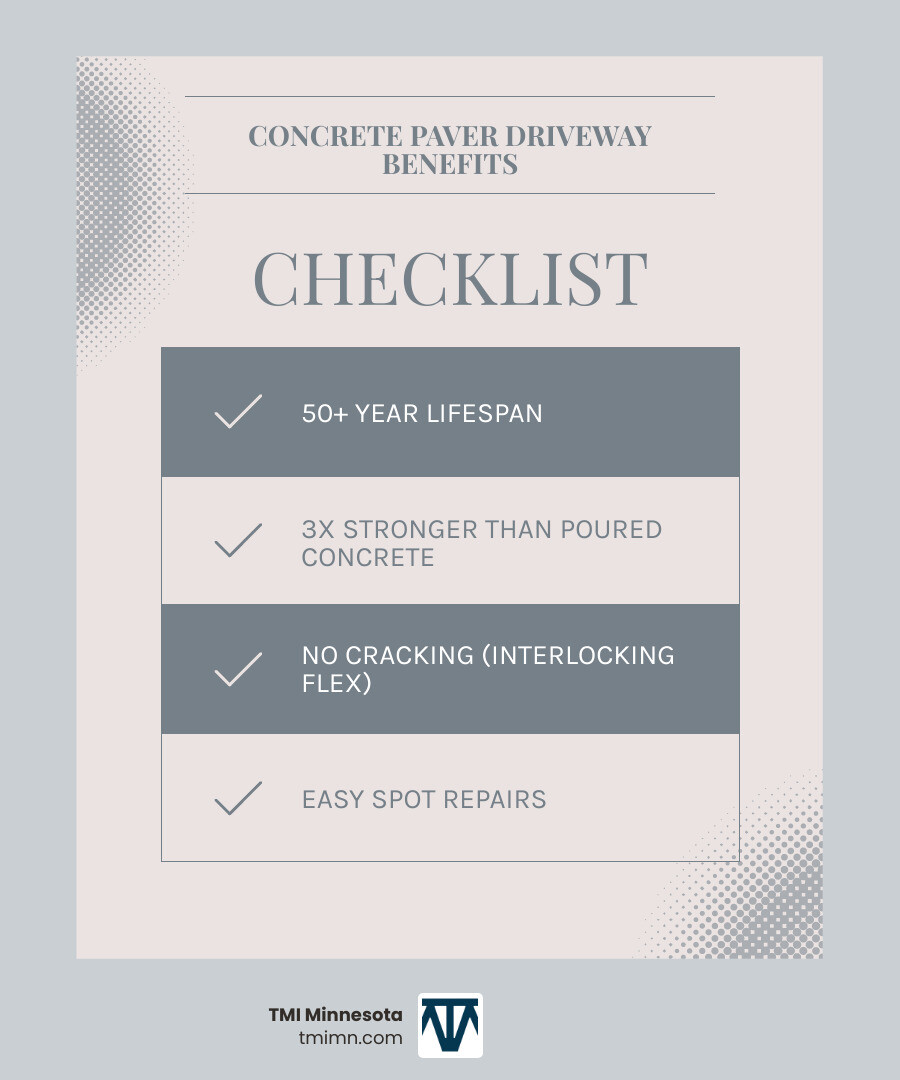
- Durability: Three times stronger than poured concrete, lasting 50+ years with minimal maintenance
- No Cracking: Interlocking design flexes with freeze-thaw cycles instead of cracking like solid concrete
- Easy Repairs: Replace individual pavers seamlessly—no ugly patches or full replacements
- Design Freedom: Unlimited colors, patterns, and textures to match your home’s style
- Smart Investment: Higher upfront cost ($10-$20 per sq ft) pays off through longevity and increased home value
A cracked, stained concrete slab or worn asphalt surface detracts from your home’s beauty and value. In contrast, concrete paver driveways offer a perfect blend of durability and aesthetic appeal. Unlike solid concrete that cracks under pressure, interlocking pavers form a flexible system. Each paver distributes weight to its neighbors, allowing the surface to handle freeze-thaw cycles and heavy vehicles without developing unsightly cracks.
The design versatility is also remarkable. From classic cobblestone to modern linear patterns, pavers provide creative freedom that poured concrete and asphalt can’t match. You can add borders, accent colors, or even permeable options for stormwater management, all while building a surface that outlasts conventional alternatives by decades.
As Christopher Deanovic, Operations Leader at Task Masters, I’ve guided countless Minnesota homeowners through the process of upgrading to concrete paver driveways, helping them understand how proper installation and material selection create an entrance that improves their home’s character while standing up to our challenging climate. Through years of designing and installing hardscapes throughout the region, I’ve seen how the right driveway transforms not just curb appeal, but the entire feel of a property.
Related content about Concrete paver driveways:
- how to install a block paving driveway
- how to remove oil from block paving driveway
- commercial block paving
Why Concrete Pavers are a Superior Choice
When we talk about upgrading your home’s exterior, especially in the Twin Cities where weather can be quite the character, the choice of driveway material is paramount. We believe concrete paver driveways stand out as a superior option, offering a blend of strength, beauty, and practicality that’s hard to beat.
The Best Durability of Concrete Paver Driveways
A driveway in Minnesota needs to be tough, withstanding extreme weather and freeze-thaw cycles. This is where concrete paver driveways truly shine. They are three times as strong as traditional poured concrete, with a typical compressive strength of 8,000 psi, allowing them to handle heavy vehicle traffic with ease.
The secret to their resilience is their interlocking system. Unlike a rigid slab of poured concrete that cracks when the ground shifts, pavers are individual units with joints that allow for slight movement. This flexibility means your driveway can “breathe” with the ground during freezing and thawing, preventing cracks and maintaining its integrity for decades. When installed properly over a well-compacted subbase, pavers distribute heavy loads across a wider area, preventing the localized stress that damages traditional concrete. This durability makes them an ideal choice for Twin Cities homeowners.
For more in-depth information on how we ensure the longevity of our outdoor projects, take a look at our insights on More info about hardscape installation.
Aesthetic Versatility and Design Freedom
Beyond their strength, concrete paver driveways offer an artistic flair that lifts your home’s curb appeal. Your driveway is a significant visual element, and pavers provide virtually limitless design possibilities. They come in a vast array of colors, shapes, and sizes, allowing us to perfectly match or complement your home’s exterior. We can create any look, from a traditional basketweave to a modern herringbone pattern. We can also incorporate borders and medallions to define edges or create unique focal points. This level of customization is simply not achievable with poured concrete. With pavers, we can craft a driveway that truly reflects your personal style and improves your home’s architecture.

As experts in More info about hardscape design services, we love helping our clients explore these options. Whether you’re aiming for a seamless integration with your existing landscape or a bold statement piece, concrete pavers provide the canvas for us to bring your vision to life.
The Simple Advantage of Repairs and Maintenance
A major advantage of concrete paver driveways is the simple repair process. Unlike poured concrete, which requires ugly patches, a damaged or stained paver can be lifted out and replaced seamlessly. This ease of spot replacement keeps your driveway looking pristine for decades.
Ongoing care is also surprisingly low maintenance. Regular sweeping and occasional rinsing are usually all that’s needed. For tougher stains, a pressure washer can be used. To protect your investment, we recommend sealing the driveway every few years to repel stains and improve color. We also use polymeric sand in the joints; this special sand hardens to lock pavers together and deter weeds and insects, meaning less time on upkeep.
For a comprehensive look at concrete driveway care, check out our More info about our Concrete Driveways Ultimate Guide.
The Financial Picture: Cost, Value, and Long-Term Savings
When considering a new driveway, cost is naturally a significant factor. While concrete paver driveways might have a higher upfront investment compared to some alternatives, we encourage our clients in the Twin Cities to look beyond the initial price tag and consider the long-term value and savings.
Upfront Installation Costs
The upfront cost of a paver installation generally ranges from $10 to $20 per square foot. For a professional installation meeting our high standards in the Minnesota climate, costs can be $17 to $24 per square foot. In comparison, poured concrete typically costs $4 to $10 per square foot. While the initial cost is higher, the long-term perspective is crucial.
The price includes materials (pavers, base materials, jointing sand) and labor (excavation, grading, base preparation, paver laying, and finishing). Project complexity, such as intricate designs or slopes, can also influence the final price.
Here’s a quick comparison:
| Feature | Concrete Paver Driveway | Poured Concrete Driveway |
|---|---|---|
| Upfront Cost (per sq ft) | $10 – $24 (generally higher) | $4 – $10 (generally lower) |
| Longevity | 30 – 50+ years | 10 – 20 years before major repairs |
| Repair Difficulty | Easy spot replacement | Difficult, often noticeable patches |
| Crack Resistance | High (flexible, interlocking system) | Low (rigid, prone to cracking) |
| Maintenance | Low (sweeping, sealing, joint sand) | Moderate (crack filling, resurfacing) |
Long-Term Value and Return on Investment
While the initial cost is higher, concrete paver driveways pay for themselves over time with exceptional long-term value. A well-installed paver driveway can last 50+ years with minimal maintenance, compared to poured concrete which often needs major repairs or replacement in 10-20 years. This longevity means lower maintenance costs and significant savings over the driveway’s lifetime.
Beyond practical savings, a paver driveway is a major upgrade to your home’s curb appeal. A beautiful design complements your home’s architecture and adds immediate value. Since 99% of realtors believe curb appeal is important for selling a home, this premium feature makes your property more attractive on the market and can increase its resale value. It’s an investment in both your daily living and your property’s marketability.
To understand how much value a paved driveway can add to your home, you might find this article insightful: An upgraded driveway adds immediate value.
Your Guide to Designing and Installing Concrete Paver Driveways
The beauty and longevity of a concrete paver driveway don’t happen by accident. They are the result of meticulous planning, proper material selection, and, most importantly, a flawless installation process. As hardscape professionals in the Twin Cities, we know that the quality of the base preparation is truly the foundation of a successful project.
Key Steps for a Flawless Installation
We often say that the unglamorous work beneath the surface is what guarantees a stunning and durable finish. Here’s a breakdown of the key steps we follow for a high-quality installation:
- Excavation and Grading: We begin by carefully excavating the driveway area. This isn’t just digging a hole; it involves precise grading to ensure proper water runoff. For a driveway, we typically excavate to at least 15 inches, or deeper if specific drainage needs or soil conditions require it. Proper grading is critical for preventing water pooling, which can undermine the entire structure over time.
- Geotextile Fabric Installation: Next, we lay a geotextile fabric. This unsung hero prevents the base material from mixing with the subgrade soil over time, maintaining the structural integrity of the base and preventing settling.
- Compacted Aggregate Base: This is arguably the most critical layer. We spread a 4-6 inch layer of well-compacted crushed stone or gravel. This layer, often referred to as “crusher run” (a mix of stone from 3/4 inch to dust), helps to spread the loads from the pavers above to the subgrade below. We compact this layer thoroughly using a plate compactor until it’s solid and perfectly level. For driveways in our Minnesota climate, a minimum of 8 to 12 inches of well-compacted base material is essential to handle freeze-thaw cycles and heavy vehicle loads.
- Sand Setting Bed: Over the compacted base, we apply a 1-inch layer of concrete sand. This sand bed provides the final leveling surface and cradles the pavers, allowing for minor adjustments during placement.
- Edge Restraints: Before laying the main pavers, sturdy edge restraints are installed around the perimeter. These are crucial for preventing the pavers from shifting or spreading outwards under vehicle traffic, maintaining the integrity of the interlocking system.
- Paver Laying: This is where the artistry begins! We carefully lay the concrete pavers directly onto the sand setting bed, following the chosen pattern. We work from a fixed edge outwards, ensuring consistent spacing and alignment.
- Jointing Sand Application: Once all pavers are in place, we sweep polymeric sand over the entire surface. This fine sand fills the joints between the pavers.
- Final Compaction: The driveway undergoes a final compaction with a plate compactor (equipped with a protective pad to prevent damage to the pavers). This vibrates the pavers into the sand bed and helps settle the jointing sand.
- Water Activation: Finally, we lightly mist the driveway with water to activate the polymeric sand, causing it to harden and lock the pavers securely in place, deterring weeds and insects.
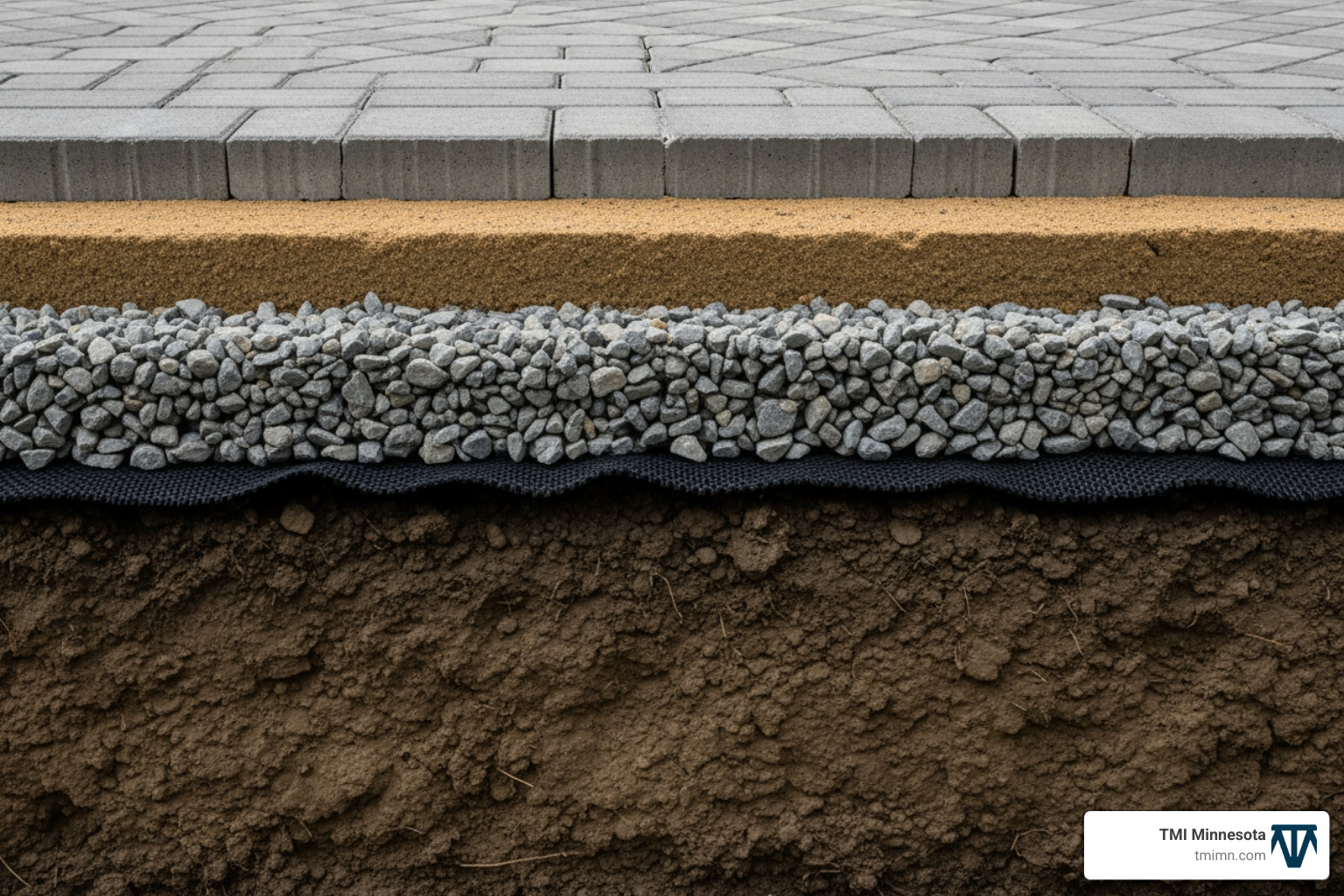
This rigorous process ensures that your concrete paver driveway is not only beautiful but also built to last through many Minnesota seasons. For a more visual guide on the process, you can refer to Laying Concrete Pavers . You can also find more details about our approach to More info about paver driveway installation.
Popular Design Patterns and Styles
The choice of paver pattern can dramatically alter the aesthetic of your driveway, changing it from merely functional to a true design statement. Here are some of the most popular patterns we work with for concrete paver driveways:
- Herringbone: This classic pattern, laid at a 45-degree or 90-degree angle, is incredibly strong and ideal for driveways. Its interlocking nature provides maximum resistance to shifting under the turning forces of vehicles, making it a top choice for high-traffic areas.
- Basketweave: Evoking a timeless, traditional look, the basketweave pattern creates the illusion of woven material, adding texture and charm.
- Running Bond: A simple yet neat pattern where pavers are laid in parallel rows, with each paver offset by half its length from the one next to it. This can create a clean, contemporary look or a more traditional feel depending on the paver choice.
- Ashlar/Random Modular: This pattern uses pavers of varying sizes laid in a seemingly random yet interlocking fashion, mimicking the look of natural stone and creating a rustic, organic feel.
- Modern Linear: For homes with a contemporary aesthetic, linear patterns using sleek, rectangular pavers laid in parallel lines or with minimal offsets create a clean, minimalist, and orderly appearance.
- Traditional Cobblestone: Utilizing pavers designed to emulate old-world cobblestones, this style brings a sense of history and European charm to your entrance.
We often combine these patterns with contrasting borders or even circular accents to create unique designs that are truly custom to your home. For more inspiration on how these patterns can transform your space, explore our More info about block paving driveway designs.
Choosing the Perfect Paver: Types and Considerations
Selecting the right paver for your driveway is an exciting part of the process, but it’s important to consider more than just aesthetics. The right choice will ensure your concrete paver driveway performs beautifully and stands the test of time, especially in our unique Minnesota environment.
Special Types of Concrete Pavers
While all concrete pavers offer superior durability, some types provide additional benefits that might be particularly appealing for your project:
Permeable Concrete Pavers: These are a fantastic option for homeowners concerned about stormwater management and environmental impact. Permeable pavers have wider joints filled with small aggregate, allowing rainwater to seep directly into the ground below, rather than running off into storm drains. This lessens the burden on municipal drainage systems, helps replenish groundwater, and prevents standing water and ice buildup on your driveway—a significant advantage during our spring thaws and heavy rains in the Twin Cities. They are an environmentally friendly choice that can also contribute to reducing surface runoff and localized flooding.
Textured and Colored Finishes: Beyond the standard smooth finish, concrete pavers come in a variety of textures, from tumbled (for an aged, natural stone look) to shot-blasted (for a more industrial, non-slip surface). Many manufacturers also offer pavers with integrated color blends or surface treatments that improve durability and stain resistance, ensuring the vibrant look lasts for years, even under the harsh Minnesota sun and snow.
- Porcelain Pavers: While technically not “concrete” pavers, modern porcelain pavers are often discussed in the same breath due to their increasing popularity for outdoor applications. Some porcelain pavers are engineered for strength and durability, mimicking the look of natural stone or wood with the added benefits of being non-porous, highly stain-resistant, and frost-resistant. However, it’s crucial to confirm if a specific porcelain paver product is rated for vehicular traffic loads before considering it for a driveway.
How to Select the Right Paver for Your Project
Choosing the ideal paver involves balancing aesthetics with practical considerations. Here’s what we consider when helping our clients make their selection:
- Climate Considerations: For us in the Twin Cities, this is paramount. We need pavers designed to withstand extreme temperature fluctuations, from deep freezes to hot summers. Look for pavers that are specifically engineered for freeze-thaw cycles. Their interlocking system allows them to flex slightly, preventing cracking, and many are also de-icing salt resistant, crucial for winter maintenance. Permeable options, as mentioned, are excellent for managing water runoff and reducing heave from frost.
- Load Requirements and Paver Thickness: Driveways endure repeated heavy loads. We recommend selecting pavers with high compressive strength and an interlocking design that are specifically rated for vehicular traffic. Driveway pavers are typically thicker than those used for patios or walkways (often 60mm or 80mm thick) to ensure they can handle the weight without settling or breaking.
- Color and Finish: This is where your personal style comes in. Consider your home’s exterior color, architectural style, and surrounding landscape. Do you want a paver that blends in or makes a bold statement? Textured finishes can add character and improve slip resistance, which is a practical benefit during wet or icy conditions.
- Texture and Slip Resistance: Especially in Minnesota, slip resistance is a vital safety feature. Many concrete pavers are naturally slip-resistant due to their textured surfaces. This is a significant advantage over smooth poured concrete, which can become treacherously slippery when wet or icy.
- Overall Aesthetic: The paver you choose should improve your home’s curb appeal and align with your vision. We help you explore various options to find the perfect blend of form and function.
Understanding the nuances of hardscape design and installation, particularly for drainage and erosion control, is something we specialize in. Learn more at More info about hardscape installation for drainage and erosion control.
Frequently Asked Questions about Concrete Paver Driveways
We often hear similar questions from homeowners considering concrete paver driveways. Here are some of the most common ones, along with our expert answers:
Will a paver driveway crack from freezing and thawing?
This is a common concern in the Twin Cities. The good news is, a properly installed concrete paver driveway will not crack from freezing and thawing. Its interlocking system is flexible, unlike a rigid slab of poured concrete. The joints between pavers allow for slight movement, accommodating the natural ground expansion and contraction caused by freeze-thaw cycles without cracking. The aggregate base and jointing sand add to this flexibility, ensuring your driveway remains intact for decades.
How do you clean and maintain a paver driveway?
Maintaining a concrete paver driveway is simple. Here’s our routine advice:
- Routine Cleaning: Sweep away debris regularly and rinse with a garden hose to remove surface grime.
- Stain Removal: Use a pressure washer with a paver-specific cleaning solution for tough stains like oil or tire marks. Be careful not to dislodge the jointing sand.
- Sealing: We recommend reapplying a paver sealer every 3-5 years to protect from UV rays, improve color, and resist stains.
- Joint Sand: Inspect joints annually and replenish with polymeric sand as needed to maintain the interlocking system and prevent weeds.
- Winter Care: Paver driveways can be plowed or shoveled. Use sand for traction or a non-corrosive deicer. Avoid rock salt (sodium chloride) and calcium chloride, as they can damage the pavers.
Can I install a paver driveway myself?
While a small patio might be a manageable DIY project, we recommend professional installation for concrete paver driveways. A driveway is a major investment that requires:
- Heavy Machinery: Proper excavation and compaction require specialized equipment that is challenging to operate without experience.
- Precise Grading: Ensuring the correct slope for drainage is critical to prevent water pooling and erosion, which can cause the driveway to fail.
- Compaction Expertise: An improperly compacted base is the leading cause of paver settling and shifting.
Mistakes during installation can lead to costly repairs that negate any initial savings. Professional expertise ensures longevity, proper function, and a stunning finish.
Transform Your Entrance with a Lasting Impression
Your home’s driveway is more than just a place to park; it’s a statement, a welcome, and a key component of your property’s overall charm and value. Choosing a concrete paver driveway is a decision to invest in both enduring beauty and unparalleled durability. With their superior strength, incredible flexibility, and ease of maintenance and repair, pavers offer a solution that traditional poured concrete simply cannot match, especially in the demanding climate of the Twin Cities.
We at TMI Minnesota are passionate about changing outdoor spaces with unique designs and leading-edge products. We believe your driveway should be a testament to quality and style, enhancing your home’s character and providing a beautiful, functional entrance for generations. Let us help you pave the way to a perfect entrance that stands strong and looks stunning, season after season.
Ready to explore the possibilities and design a concrete paver driveway that truly reflects your home’s unique appeal? Explore our block paving driveway designs and contact us today to discuss your vision. We’re here to guide you every step of the way, ensuring your path to a perfect entrance is smooth, beautiful, and built to last.