
Why Garden Art Can Transform Your Outdoor Space
Garden art installations bring personality, beauty, and meaning to outdoor spaces—from temporary living sculptures that bloom with the seasons to permanent focal points crafted from glass, stone, or recycled materials. Whether you’re drawn to kinetic aerial works that dance in the wind, luminous glass flowers that catch the light, or natural installations that honor the earth, garden art transforms yards into personal galleries that reflect your style and values.
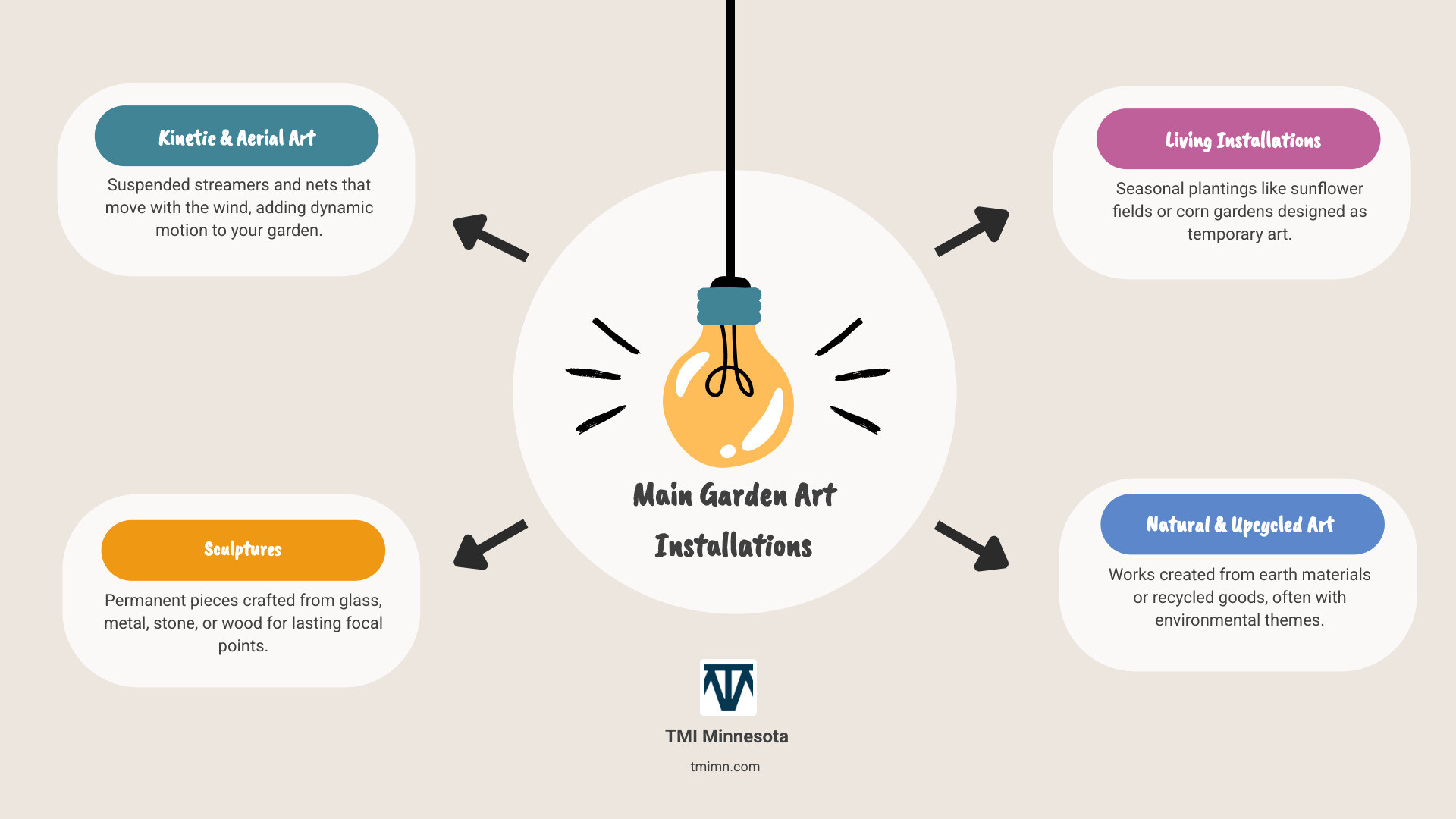
Here are the main types of garden art installations you can explore:
- Kinetic & Aerial Art – Suspended streamers and nets that move with wind
- Sculpture – Permanent pieces in glass, metal, stone, or wood
- Living Installations – Seasonal plantings designed as art (sunflowers, corn gardens)
- Natural & Upcycled Art – Works created from earth materials or recycled goods
- Water Features – Fountains and ponds as artistic focal points
- Light Installations – Art that interacts with natural or artificial light
Your yard is a canvas. Like the botanical gardens showcasing Dale Chihuly’s vibrant glass sculptures or Patrick Shearn’s flowing aerial installations, your outdoor space can express who you are while enhancing curb appeal and creating gathering spots for family and friends. The right art installation doesn’t just beautify—it transforms how you experience and use your landscape.
At TMI Minnesota, we’ve helped countless Minnesota homeowners integrate thoughtful design elements into their landscapes, including garden art installations that serve as stunning focal points. Our approach blends creative vision with practical execution to ensure every piece improves both beauty and function.
Garden art installations vocab to learn:
The Spectrum of Garden Art: From Ephemeral to Everlasting
Garden art installations come in many forms, each with its own impact and purpose. We see a fascinating spectrum, from works designed to evolve and disappear with the seasons to those intended to stand the test of time, becoming enduring landmarks in a landscape. This versatility is one of the many reasons we love incorporating unique garden features into our designs here in the Twin Cities.

Temporary & Living Installations
Temporary installations are all about capturing a moment, celebrating seasonal beauty, or marking special events. They often engage with the natural cycles of growth and decay, offering a dynamic experience that changes over time. Their purpose can range from artistic expression to community engagement or even ecological statements.
For example, artists Ekua Holmes and Elizabeth James-Perry created a “Garden for Boston” that transformed a museum’s front lawn. Holmes’s “Radiant Community” involved planting thousands of sunflowers, symbolizing hope and community empowerment. James-Perry’s “Raven Reshapes Boston: A Native Corn Garden” used traditional Indigenous planting techniques to grow corn, beans, and sedges in mounds shaped like a horseshoe crab. This wasn’t just about aesthetics; it was about highlighting Indigenous presence and a reciprocal relationship with the land. These living installations offer a powerful, evolving narrative.
Similarly, artist Sheila Pepe’s “My Neighbor’s Garden” demonstrated how art can integrate with horticulture in public spaces. Her elaborate crochet structures became living trellises for heirloom vegetables and flowering vines. The installation evolved throughout the season as the plants grew and intertwined with the artwork, creating a dynamic, ever-changing piece. This type of softscape design shows how organic elements can be central to an art piece, rather than just a backdrop.
These temporary, living installations are fantastic for creating seasonal interest or for making a statement that evolves with nature. They invite contemplation on themes of growth, change, and the ephemeral nature of beauty, making them perfect for community gardens or special events.
Permanent Installations
In contrast, permanent garden art installations are designed for lasting impact, offering a constant focal point and enduring beauty. Their durability often stems from the materials used, such as stone, metal, or glass, and their purpose can be to commemorate, inspire, or simply to add a timeless artistic element to a landscape. We often integrate durable, beautiful elements into our hardscape installations to ensure they improve a property for years to come.
Andy Goldsworthy’s ‘Garden of Stones’ exemplifies a powerful permanent installation. This work, designed as a living memorial, features eighteen boulders, each with a dwarf oak sapling growing from its top. It symbolizes the tenacity and fragility of life, linking the ephemeral (the growing tree) with the timeless (the stone). In Jewish tradition, stones are placed on graves as a sign of remembrance, adding profound depth to this installation. It’s a reminder that art can be both beautiful and deeply meaningful, evoking contemplation and memory.
Another example of enduring art in a natural setting is Chris Drury’s ‘Cloud Chamber’. This impressive piece is constructed from nearly 120 tonnes of Cornish granite and slate, forming a meditative chamber that interacts with its environment. The sheer scale and material choice ensure its permanence and its ability to withstand the elements, becoming a timeless feature within the landscape.
These permanent installations provide a sense of stability and continuity, offering year-round visual interest and often becoming iconic elements of the spaces they inhabit. They require careful planning for placement and material selection to ensure they not only last but also improve their surroundings over time.
Inspiring Garden Art Installations and the Artists Behind Them
Garden art installations are often the brainchild of visionary artists who push the boundaries of materials and concepts. Their work transforms public spaces and botanical gardens into immersive experiences, demonstrating how art and nature can coalesce. As landscape design experts, we draw inspiration from these innovative approaches, thinking about how we can bring similar creativity to our clients’ yards in the Twin Cities.

Immersive Aerial & Kinetic Art
Imagine art that dances with the wind, constantly shifting and shimmering in the sunlight. That’s the magic of immersive aerial and kinetic art. Patrick Shearn, through his company Poetic Kinetics, is a master of this form. His ‘Skynet Art Series’ creates breathtaking installations that seem to float effortlessly, changing the air itself into a canvas.
One notable example is ‘Dream Flora’, an aerial installation composed of red, orange, purple, and yellow nylon streamers attached to webs of fishing net. These massive, flowing sculptures are suspended by ropes in trees, extending over pathways and even canopy walks. The kinetic sculpture glides through the air like a flock of birds, offering a “trippy wonderland” experience. Another of his works, ‘Flora in Flight’, is a trilogy of large-scale kinetic artworks, each specifically designed for its environment. One such piece features 9,519 colorful streamers or 7,896 hand-attached ribbons and numerous hand-tied knots, creating vast, fluid canvases of color that constantly move with the wind.
What makes Shearn’s work so impactful is its responsiveness to natural elements. The wind becomes a collaborator, shaping the art moment by moment. This creates a truly immersive experience, where visitors are encouraged to look up and connect with the subtle movements of the air. When we consider decorative outdoor structures for our Twin Cities clients, we often think about how elements can interact with the environment, bringing a dynamic quality to the landscape.
Luminous Glass Sculptures
Glass art in gardens brings a unique blend of vibrant color, intricate form, and captivating light interaction. Dale Chihuly is perhaps the most renowned artist in this field, known for his monumental and often organic glass sculptures that seem to grow out of the landscape. His work is often found in botanical gardens, where it creates a stunning dialogue with the surrounding flora.
For instance, Chihuly’s ‘Parterre Fountain Installation’ is a one-of-a-kind sculpture in blue and white, interpreting the shapes and colors of water, ice, and sky. It’s a captivating assemblage of twisting, brightly colored glass that improves the fountain area. Other pieces, like his ‘Radiant Yellow Icicle Tower’ or ‘Nepenthes Chandelier’, use glass to create guides of color and light, drawing the eye and adding a whimsical, jewel-like quality to the garden.
Another artist making waves with glass in natural settings is Jason Gamrath. His contemporary glass sculptures represent blooming plants like orchids, pitcher plants, and lotuses, often crafted without the use of molds. These “insanely beautiful” pieces bring a hyperrealistic yet fantastical element to gardens, with their vibrant colors and delicate structures. The way they capture and refract light adds another dimension to the garden experience, especially as the sun moves throughout the day. Integrating thoughtful outdoor lighting installations can further improve the magic of such pieces after dusk.
Both Chihuly and Gamrath demonstrate how glass, a seemingly fragile material, can be transformed into robust and visually stunning garden art installations that improve the natural environment. Their work enriches the visitor experience by introducing unexpected bursts of color and form, making the garden feel like an open-air gallery.
Art from the Earth: Natural & Upcycled Materials
Some of the most profound garden art installations draw their power from the very materials of the earth or from repurposed objects, offering deep environmental messages and unique aesthetics.
Andy Goldsworthy, as we discussed with his ‘Garden of Stones’, is a master of using natural elements like stones, leaves, ice, and wood to create site-specific works that blend seamlessly with their environment. His art often highlights the beauty and transience of nature, and the cycle of life and decay. The sheer simplicity yet profound impact of his creations makes them unforgettable.
Daniel Attaboy Seifert takes a different approach with his ‘The Upcycled Garden’ installation. He uses locally sourced recycled cardboard and house paint/spray paint remnants to create sculptures that are “beautiful and organic on the outside” but reveal a “visual diary of consumption” on their hidden side—pizza boxes, COVID tests, Amazon boxes. This touring concept started as a therapeutic response during lockdown and to post-car crash PTSD, changing personal struggle into a public commentary on consumer waste and sustainability. It’s a powerful example of how eco-friendly landscape design can extend to the art we choose.
Jenny Kendler’s ‘Birds Watching’ sculpture further illustrates environmental themes. This 40-foot-long artwork is composed of a “flock” of one hundred reflective birds’ eyes, each belonging to a species endangered by climate change. The reflective quality of the eyes creates a striking visual, while the underlying message serves as a poignant reminder of our impact on the planet.
These artists show us that garden art installations don’t always need to be grand or expensive. They can be created from humble, repurposed, or natural materials, carrying deep meanings about our connection to the environment, our consumption habits, and our responsibility to the planet.
Community and Culture in Garden Art Installations
Garden art installations can also be powerful vehicles for community engagement, cultural storytelling, and social commentary. They often emerge from collaborations, drawing on local histories, traditions, and collective experiences to create art that resonates deeply with people.
Sheila Pepe’s ‘My Neighbor’s Garden’ is a brilliant example of community-inspired art. Drawing inspiration from community gardens in her Brooklyn neighborhood, Pepe created an outdoor exhibition that blended her feminist crochet practice with horticulture. The installation evolved as vining plants like bitter melon and morning glory grew over and through her structures, symbolizing growth, connection, and the intertwining of nature and human creativity. This project highlights how art can integrate with green spaces to foster a sense of belonging and critique traditional norms.
The ‘Garden for Boston’ exhibition, featuring Ekua Holmes and Elizabeth James-Perry, further demonstrates the power of garden art to convey cultural narratives. Holmes’s ‘Radiant Community’ transformed a museum lawn with thousands of sunflowers, symbolizing hope and resilience for a historically Black neighborhood. James-Perry’s ‘Raven Reshapes Boston: A Native Corn Garden’ used traditional planting methods to assert enduring Indigenous presence and promote a reciprocal relationship with the land. This project was not just an art display; it was a counter-narrative, engaging with existing public sculptures and offering new perspectives on history and community. Learn about the ‘Garden for Boston’ project to see how art can challenge and redefine public spaces.
These installations underscore that garden art can be much more than decorative. It can be a vibrant part of community life, celebrating diverse cultures, promoting native plant landscaping, and creating spaces for dialogue and reflection. For us, helping Twin Cities communities integrate such meaningful art into their shared green spaces is a privilege.
Integrating Art into Your Own Landscape Design
Bringing garden art installations into your own landscape design is about personalizing your outdoor space, changing it into a reflection of your unique style and values. Whether you have a sprawling estate or a cozy urban plot, thoughtful integration of art can lift your yard from merely functional to truly extraordinary. It’s about creating a backyard oasis that speaks to you.
Planning Your Own Garden Art Installations
Before diving in, consider a few key aspects to ensure your garden art improves, rather than detracts from, your landscape. We always emphasize careful planning in all our projects, from landscape design for small yards to large-scale changes.
- Functionality: What role will the art play? Is it a focal point, a subtle accent, or a functional piece like a bench or a unique planter?
- Durability: Especially here in the Twin Cities with our varied climate, choose materials that can withstand Minnesota’s harsh winters and humid summers. Stone, treated metals, or specific types of glass are often good choices for permanent outdoor display.
- Budget: Garden art installations can range from DIY projects using recycled materials to commissioned sculptures. Have a clear budget in mind.
- Scale: The size of your art should be proportionate to your space. A massive sculpture might overwhelm a small patio, while a tiny piece could get lost in a large garden. Consider how it will look from different vantage points.
- Focal Points: Art can draw the eye and create intentional viewing experiences. Place larger pieces or those with strong visual impact where you want to create a natural stopping point or a “wow” moment.
- Curb Appeal: 99% of realtors believe curb appeal is important to selling a home. Well-chosen art can significantly boost your home’s exterior aesthetic.
When planning, think about your existing landscape architecture. Is your style modern, rustic, traditional, or eclectic? Your art should ideally complement this, or intentionally contrast it to create an interesting dynamic.
Combining Hardscape and Softscape with Art
The true artistry in landscape design often lies in how hardscape (patios, walkways, retaining walls) and softscape (plants, trees, flowers) are integrated. Garden art installations act as a perfect bridge between these elements, creating a cohesive and harmonious outdoor environment.
- Art on Patios: A striking sculpture can define an outdoor living room on your patio, complementing your outdoor furniture. Imagine a sleek metal sculpture against the backdrop of a modern patio design.
- Sculptures in Garden Beds: Placing a weather-resistant sculpture amidst lush plantings creates a delightful surprise. The plants can soften its lines, and the art can provide year-round structure even when flowers aren’t in bloom.
- Water Features as Art: Fountains and ponds aren’t just for sound; their design can be a form of art itself. A contemporary fountain can be a minimalist sculpture, while a naturalistic pond with strategically placed stones becomes a living artwork. We specialize in designing and installing beautiful backyard water features that serve as both calming elements and artistic focal points.
- Cohesive Design: The goal is for the art to feel like an integral part of your landscape, not an afterthought. This means considering color palettes, textures, and themes that tie everything together. Our expertise in hardscape and softscape allows us to create designs where every element, including art, feels perfectly placed.
Whether it’s a permanent stone piece nestled among native plants or a temporary display of seasonal flowers arranged artistically, integrating art carefully ensures your landscape is a truly curated experience.
The Role of Public Spaces in Showcasing Art
Public spaces, from botanical gardens to city parks and museum grounds, play a crucial role in bringing garden art installations to a wider audience. They serve as expansive outdoor galleries, making art accessible and enhancing the visitor experience in profound ways.
Here in the Twin Cities, we’re fortunate to have iconic examples like the Minneapolis Sculpture Garden. Its collection of contemporary sculptures, set amidst beautifully landscaped grounds, allows residents and visitors alike to engage with art in an open, natural environment. The famous “Spoonbridge and Cherry” is a perfect example of how art can become a beloved landmark, blending whimsy with monumental scale.
Botanical gardens, like the Atlanta Botanical Garden, are particularly adept at showcasing art. They often feature permanent collections, such as the largest permanent display of works by Dale Chihuly in a botanical garden. These gardens use art to create immersive environments, where the beauty of nature is amplified by human creativity. The art pieces become part of the journey, drawing visitors through different garden rooms and offering unexpected visual delights. For example, Chihuly’s installations with their vibrant colors and unique shapes improve the garden’s natural beauty and create a truly memorable experience. Atlanta Botanical Garden is a prime example of this synergy.
These public displays highlight several benefits of garden art installations:
- Accessibility: Art moves beyond gallery walls, reaching people of all ages and backgrounds.
- Improved Visitor Experience: Art adds an extra layer of engagement, encouraging longer visits and deeper contemplation.
- Community Identity: Unique installations can become symbols of a city or neighborhood, fostering civic pride.
- Educational Opportunities: Many public art pieces, especially those with environmental or cultural themes, offer educational insights.
We believe that public outdoor entertainment spaces in the Twin Cities can greatly benefit from incorporating thoughtful garden art installations, creating more engaging and inspiring environments for everyone.
Conclusion
From the ephemeral dance of kinetic aerial sculptures to the enduring presence of stone memorials, garden art installations offer a boundless field of creativity for changing outdoor spaces. We’ve explored how artists like Patrick Shearn and Jason Gamrath craft immersive experiences, how Andy Goldsworthy and Daniel Attaboy Seifert use natural and upcycled materials to convey powerful messages, and how Sheila Pepe, Ekua Holmes, and Elizabeth James-Perry weave community and culture into their living artworks.
Whether temporary or permanent, these installations prove that your yard is far more than just grass and plants—it’s a canvas for personal expression, a space for contemplation, and an opportunity to connect with art and nature in meaningful ways. By carefully considering materials, scale, purpose, and integration with both hardscape and softscape, you can create a landscape that truly reflects your style and values.
At TMI Minnesota, we’re passionate about helping our Twin Cities clients realize the full potential of their outdoor environments. Our team combines creative vision with leading-edge products and expert craftsmanship to design and install custom landscapes that are not only beautiful and functional but also deeply personal. If you’re ready to infuse your yard with unique character and artistic flair, we’re here to guide you. Let us help you create a landscape that’s a true masterpiece, reflecting who you are and enhancing your everyday life.
Ready to transform your outdoor space? Contact our landscape design experts today!