
Illuminating Your Outdoor Space: The Magic of Light
Landscape lighting ideas transform ordinary yards into captivating nighttime retreats. Here are the most popular options at a glance:
- Path Lights: Guide visitors safely along walkways (space 10-15 feet apart)
- Uplights: Highlight trees, architecture, and garden features
- String Lights: Create ambiance over patios and gathering areas
- Well Lights: Recessed ground fixtures for subtle illumination
- Spotlights: Focus attention on specific landscape elements
- Wall Sconces: Frame entrances and add architectural interest
- Deck/Step Lights: Improve safety on stairs and liftd areas
Well-designed landscape lighting does more than just illuminate—it creates ambiance, improves safety, extends your living space, and significantly boosts property value. The right lighting turns your yard into a 24-hour showcase while deterring potential intruders and preventing trips and falls.
The best lighting designs layer different fixture types, combining practical illumination with artistic accents. Like a theater production, your yard becomes the stage, with lighting directing attention to the most beautiful features while discreetly hiding less attractive areas.
I’m Christopher Deanovic, Operations Leader at Task Masters, where I’ve transformed countless Minnesota properties through strategic landscape lighting ideas that blend functionality with visual drama, creating outdoor spaces that continue to impress long after sunset.

Landscape lighting ideas vocab to learn:
– Backyard patio ideas
– Hardscape design services
– Landscape renovation services
Why Outdoor Lighting Matters
As the sun sets over Minnesota, most homeowners retreat indoors, leaving beautiful landscapes to disappear into darkness. But what if your outdoor space could come alive after dark? With thoughtful landscape lighting ideas, your yard transforms into a 24-hour living space that serves multiple important purposes.
Safety comes first in any lighting plan. Those beautiful stone pathways and garden steps can become hazards after dark, especially during our long Minnesota winters. Properly lit walkways prevent trips and falls that could turn a lovely evening into an emergency room visit. I recently spoke with a client who laughed about how her family used to “play hopscotch in the dark” before installing path lights. “Now our friends actually stay on the walkway instead of trampling my perennials!”
Security is another compelling reason to light up your landscape. Research shows well-illuminated properties experience up to 39% fewer break-ins. Strategic lighting near entry points, along with motion-activated fixtures in vulnerable areas, creates an environment that’s decidedly unwelcoming to potential intruders. Plus, there’s nothing better than having your walkway automatically illuminate when you’re fumbling with groceries after dark.
Your home’s curb appeal doesn’t need to vanish at sunset. A thoughtfully lit exterior dramatically improves your property’s nighttime presence and value. “Our house used to disappear after dark,” one Twin Cities homeowner told me. “Now it’s the showcase of the neighborhood 24/7.” First impressions happen day and night, and a beautifully lit landscape speaks volumes about the care you’ve invested in your property.
Perhaps most valuable is how outdoor lighting extends your living space beyond daylight hours. That beautiful patio or deck you invested in deserves more than daytime use. With proper lighting, evening gatherings can stretch well into fall. As another client shared, “We used to head inside at dusk, but now we’re curling up under our pergola with blankets and enjoying our yard until bedtime.”
Think of your landscape as a theater production where lighting directs attention to the most beautiful features while creating an atmosphere of hospitality and warmth. Your outdoor space deserves the same expert treatment as a Broadway show—and at TMI Minnesota, we’re ready to help you direct it perfectly.
Landscape Lighting Ideas: Fixture Playbook
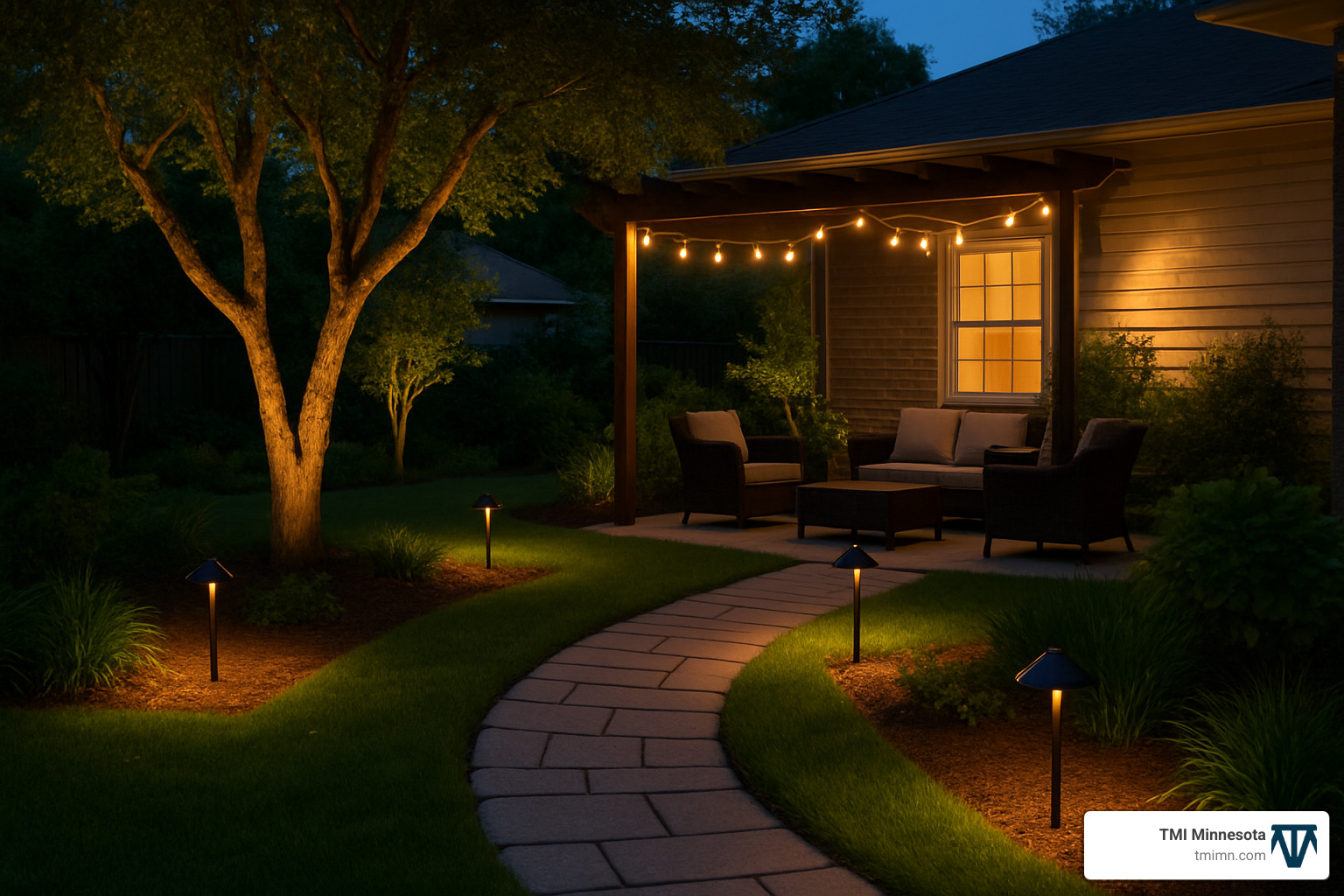
Think of your outdoor lighting as a cast of characters, each playing a unique role in your nighttime landscape story. Before we jump into creating your lighting masterpiece, let’s get to know the key players that can transform your yard after dark.
Path lights are the friendly guides of your landscape, standing 18-24 inches tall and casting gentle pools of light downward. We typically place these 10-15 feet apart along walkways, though solar versions might need to be a bit cozier at 6-8 feet. One of our Twin Cities homeowners told me with a laugh, “Our path lights not only save our ankles, but they make walking to our front door feel like following a trail of magic breadcrumbs!”
When you want to create drama and draw attention to something special, spotlights are your go-to performers. With focused beams between 15-45 degrees, they’re perfect for highlighting that Japanese maple you’re so proud of or the stonework on your home’s facade. Unlike their cousins, flood lights, spotlights don’t blast light everywhere—they’re more like a theater spotlight that says “look here!”
For broader coverage, flood lights sweep wide beams (45+ degrees or more) across driveways, lawns, or your home’s facade. Today’s LED versions give you all that light without the shocking electric bill—a win-win for visibility and your wallet.
Nothing says “gather here” quite like string lights. They’re the crowd-pleasers of the lighting world, creating instant magic when strung over patios and pergolas. “Everyone who visits immediately gravitates to our string-lit patio,” one Edina client told me. “It’s like they’re drawn to the warmth like moths—but in a good way!”
For defining edges and outlines, flexible rope lights can trace garden beds, highlight steps, or emphasize architectural features. I’ll never forget the client who gasped when we lit up her brick-edged flower beds with embedded rope lighting—that subtle glow completely transformed her garden’s nighttime presence.
Wall sconces bring both beauty and function to vertical surfaces. They’re excellent for framing doorways or illuminating outdoor living areas with character. Their close cousins, lanterns, add that old-world charm whether hanging from tree limbs or perched on posts. We recently created what a client called an “enchanted forest” by hanging copper lanterns from mature oak branches—sometimes the simplest solutions create the most magical effects.
For wider walkways or areas needing substantial guidance, bollards stand like friendly sentinels, casting broader light than traditional path fixtures. And don’t forget underwater lights, which bring water features to life after dark. As one delighted client put it, “Our pond was just a black hole at night until we added underwater lighting—now it’s the star of our evening landscape!”
By understanding how each fixture type contributes to your outdoor lighting ensemble, we can create a layered design that addresses both practical needs (like not tripping over the garden hose) and aesthetic goals (like making your yard look like it belongs in a magazine). The right combination turns your Minnesota yard into a nighttime retreat that you’ll never want to leave—even when the mosquitoes start buzzing.
Landscape lighting ideas for Pathways & Entries
The journey to your door should be both safe and enchanting. Pathway and entry lighting serves as your home’s nighttime welcome mat, guiding visitors while creating an inviting atmosphere.
For primary walkways, we recommend a combination of path lights and downlights. Path lights should be staggered rather than placed in straight lines on both sides, which can create an unwanted “runway” effect. As one landscape lighting designer puts it, “You want to create pools of light that guide the eye forward, not a continuous strip of illumination.”
In the Twin Cities, where winter brings early darkness, we’ve found that spacing path lights approximately 10-15 feet apart provides optimal guidance without overwhelming the landscape. For solar-powered options, which typically produce less light, spacing should be tighter at 6-8 feet.
Garden-style path lights standing 18-24 inches tall work beautifully for traditional homes, while modern properties might benefit from flush-mounted fixtures or contemporary bollards. For a recent project in Edina, we installed copper path lights that have developed a beautiful patina, blending seamlessly with the client’s established garden.
Entry points deserve special attention. Flanking your front door with a pair of wall sconces creates symmetry and welcome. For a dramatic entrance, consider downlighting from a nearby tree or architectural element, creating a natural moonlight effect over your entry path.
For longer driveways, bollard lights provide broader illumination than standard path lights. One client with a winding rural driveway opted for bollards spaced 20 feet apart, creating a gentle rhythm of light that guides visitors while preserving the rural character of their property.
Steps require particular attention for safety reasons. Riser lights installed into stair faces not only prevent trips but create a floating effect that adds visual interest. For a recent project, we integrated undercap lights into stone steps, providing subtle illumination that highlights the beautiful stonework while ensuring safe passage.
Your entry lighting sets the tone for your entire property. As one client told us, “The way our pathway lights lead to our brightly lit front door makes everyone feel welcome before they even knock.”
More info about Outdoor Lighting Installations
Landscape lighting ideas for Architecture & Trees
Your home’s architecture and landscape features deserve to shine after dark. Strategic lighting can transform ordinary elements into nighttime focal points, creating drama and depth throughout your property.
For architectural lighting, we employ several techniques depending on the desired effect. Uplighting, where fixtures are placed at ground level pointing upward, creates dramatic shadows and highlights texture. This technique works beautifully on stone facades, columns, and architectural details.
One Minnetonka client with a striking contemporary home wanted to emphasize its unique angles. We installed narrow-beam uplights at key points, creating a sculptural play of light and shadow that reveals the home’s architectural character after dark. “My house looks even more interesting at night than during the day,” the homeowner remarked.
For trees, lighting approach depends on the specimen. Deciduous trees with interesting branch structures benefit from uplighting that highlights their “bones.” Evergreens often look best with a combination of uplighting for the trunk and downlighting through the branches to create depth.
“Your landscape is a stage,” as one lighting designer puts it. “And like a stage, your landscape will need dramatic lighting design to make it a real showstopper.” This theatrical approach is particularly effective with mature trees, which can become dramatic sculptures when properly lit.
Moonlighting is a particularly magical technique where lights are placed high in trees pointing downward, mimicking natural moonlight filtering through branches. For a Lake Minnetonka property, we installed downlights in several large oaks, creating dappled patterns on the patio below. “It feels like we’re sitting under permanent moonlight,” the client told us.
Façade washing involves positioning lights to gently illuminate an entire wall, creating a soft glow that highlights the home as a whole rather than specific features. This technique works beautifully for highlighting the general presence of your home without creating harsh shadows.
For one historic home in St. Paul, we combined subtle façade washing with focused accent lighting on architectural details, creating a layered effect that respects the home’s character while ensuring it doesn’t disappear after dark.
When highlighting architecture and trees, less is often more. As one lighting expert advises, “Highlight man-made objects with warm light and plants with cool light for optimal effect.” This subtle difference in color temperature creates natural visual separation between different elements in your landscape.
Landscape Lighting Forum VOLT® University: How-To Articles
Design & Layout Techniques

Creating beautiful landscape lighting ideas is a bit like painting with light—it requires both artistic vision and technical know-how. I’ve seen countless Minnesota homeowners surprised by the difference between DIY attempts and professional designs, and it almost always comes down to thoughtful planning.
At TMI Minnesota, we start every lighting project with a thorough property walk-through. We map out how you actually use your space—where you walk, where you gather, and which features deserve the spotlight. This becomes our canvas for creating magic after dark. One principle we live by: “Treat lighting as integral, not an afterthought.” The most stunning outdoor lighting is considered from the very beginning of a landscape project, not tacked on at the end like an afterthought.
Understanding beam spread makes all the difference in your lighting’s impact. Think of it as controlling how wide your light “brush strokes” will be. Narrow beams (15-30 degrees) create dramatic spotlights for specific treasures, while wider beams (30-60 degrees) wash larger areas with gentle illumination. For a lakeside property in Wayzata, we used narrow beams to highlight their gorgeous specimen maples and wider beams to softly illuminate garden beds, creating visual layers that draw the eye through the landscape.
The warmth or coolness of your light dramatically affects the mood. We measure this in Kelvins (K), where lower numbers create cozy, amber glows and higher numbers produce crisp, moonlight effects. Most Twin Cities homes look best with warm lighting (2700-3000K) for living spaces and slightly cooler lighting for plants and water features. One client told me, “I had no idea the temperature of light could completely change how my garden feels at night!”
| Technique | Best Uses | Placement | Effect |
|---|---|---|---|
| Uplighting | Trees, architecture, statuary | Ground level pointing up | Dramatic, emphasizes texture and height |
| Downlighting | Pathways, patios, planting beds | Above feature pointing down | Natural, mimics moonlight, gentle illumination |
| Spotlighting | Focal points, specimen plants | Various angles, focused beam | Creates emphasis, draws attention |
Spacing your fixtures takes a delicate touch. Rather than creating airport-runway-style continuous illumination, we aim for rhythmic pools of light that guide the eye naturally. A good rule of thumb: space fixtures about 20 feet apart to create inviting stepping stones of light rather than harsh, continuous brightness.
One common mistake I see in DIY landscape lighting ideas is choosing fixtures that stick out like sore thumbs during daylight hours. We carefully select fixtures that either blend seamlessly with your landscape or become attractive design elements in their own right. For an Eden Prairie project last year, we installed copper fixtures that complement the client’s garden ornaments—they look beautiful even before they’re switched on at dusk.
The best lighting doesn’t draw attention to the fixtures themselves but to what they illuminate. Your guests should notice your beautiful Japanese maple or stone wall—not the spotlight highlighting it. As one delighted client put it, “It’s like my garden suddenly has a nighttime personality I never knew existed.”
More info about Garden Lighting Installation
Planning Your Grid
The invisible backbone of gorgeous landscape lighting ideas is a well-planned electrical system. Think of it as the behind-the-scenes work that makes the magic possible—like a theater’s lighting grid that the audience never sees but that makes every performance shine.
Most modern landscape lighting runs on low-voltage (12V) power, which is safer, more energy-efficient, and much easier to install than traditional high-voltage systems. The heart of this setup is the transformer—a box typically mounted near your home’s exterior that converts your standard 120V household power to the gentler 12V needed for landscape fixtures.
Sizing your transformer correctly is absolutely critical. We follow what we call the “125% rule”—always selecting a transformer with capacity 25% greater than your current lighting needs. This built-in buffer allows you to expand your system later without starting from scratch. For example, if your initial design requires 400 watts, we’ll install a 500-watt transformer. As one client finded after trying to save money on a smaller transformer: “Spending a little more upfront would have saved me from completely replacing it a year later when we wanted to add more lights.”
The thickness (gauge) of your wiring and how you lay it out has a huge impact on performance. For main runs from the transformer, we typically use heavier 10-gauge cable, branching to 12-gauge for connections to individual fixtures. This prevents the common problem of “voltage drop,” where lights farther from the transformer appear dimmer than those nearby.
For larger Minnesota properties, we often create what we call a hub system with equal-length cable runs. This smart design maintains consistent brightness across all your fixtures. One client in Minnetrista was frustrated that their existing DIY system had bright fixtures near the house but barely-visible ones at the property edges. When we redesigned their grid with proper cable sizing and a hub layout, they were amazed that every light finally glowed with the same warm intensity.
Safety is non-negotiable with outdoor electrical work. All transformers should connect to GFCI-protected circuits (those special outlets with the “test” and “reset” buttons), and every connection must be made in waterproof junction boxes. As my electrician friend bluntly puts it, “Water and electricity don’t mix—every connection must be properly protected.”
For complex installations, we create detailed wiring diagrams showing exactly where everything goes. This documentation becomes invaluable when you want to expand your system or troubleshoot years down the road. One grateful client kept our diagram in her garden folder and told me, “When we added the new patio three years later, having that map made adding lights so much easier!”
With thoughtful planning, your lighting grid will provide years of trouble-free performance, creating beautiful effects while remaining completely invisible to anyone enjoying your illuminated landscape.
Highlighting Water & Hardscape
Water features and hardscape elements offer some of the most magical opportunities for landscape lighting ideas. When skillfully illuminated, these features transform from daytime accents into nighttime showstoppers.
Water and light create an almost hypnotic partnership. For ponds and reflecting pools, we often place submersible LED fixtures beneath the surface, creating an ethereal glow that seems to come from within. One client with a koi pond in Maple Grove told me, “During the day, visitors watch the fish. At night, they’re mesmerized by the light dancing on the water’s surface. It’s two completely different experiences.”
Fountains become dynamic sculptures when properly lit. By positioning uplights to capture the movement of falling water, we create constantly changing patterns of light and shadow. For a recent Edina installation, we placed waterproof lights to illuminate water as it cascades down a natural stone waterfall. The homeowner loves to enjoy evening coffee beside it, saying, “It’s especially magical during our long Minnesota winters when everything else seems dark and still.”
Swimming pools benefit from thoughtful lighting both in and around the water. Recessed well lights along the pool deck create a safe boundary while highlighting the water’s surface. For a Lake Minnetonka property, we combined blue underwater lights with warm perimeter fixtures, creating a striking contrast that defines the pool area after dark while making nighttime swims more inviting.
Hardscape elements like walls, steps, and patios offer perfect opportunities for integrated lighting that’s both practical and beautiful. Undercap lights tucked beneath wall capstones create the illusion that heavy stone is floating while providing gentle illumination for pathways. One client with a gorgeous natural stone retaining wall was amazed at how undercap lighting completely transformed the wall’s appearance: “During the day it’s impressive, but at night it becomes absolutely spectacular.”
Steps and level changes present both safety concerns and creative lighting possibilities. Riser lights embedded in stair faces prevent trips and falls while creating a dramatic cascading effect. For a multi-level Wayzata terrace, we installed slim LED strips along each step riser, creating the illusion of floating steps that safely guide visitors between levels. The homeowner noted, “Our friends always comment on how beautiful the steps look, not realizing the lighting was primarily installed for safety.”
Patios and outdoor living spaces shine with a thoughtful mix of ambient and task lighting. Downlights mounted in nearby trees create a natural moonlight effect, while focused task lighting near outdoor kitchens and dining areas ensures you can see what you’re cooking and eating. String lights overhead add that perfect touch of magic that encourages guests to linger long after sunset.
With hardscape lighting, subtlety usually wins. As I often tell clients, “Brighter isn’t always better—aim for a balanced, inviting effect rather than floodlight-style illumination.” The goal is to improve your outdoor living experience, not recreate daylight.
More info about Landscape Renovation Services
Budget, Energy & Smart Tech
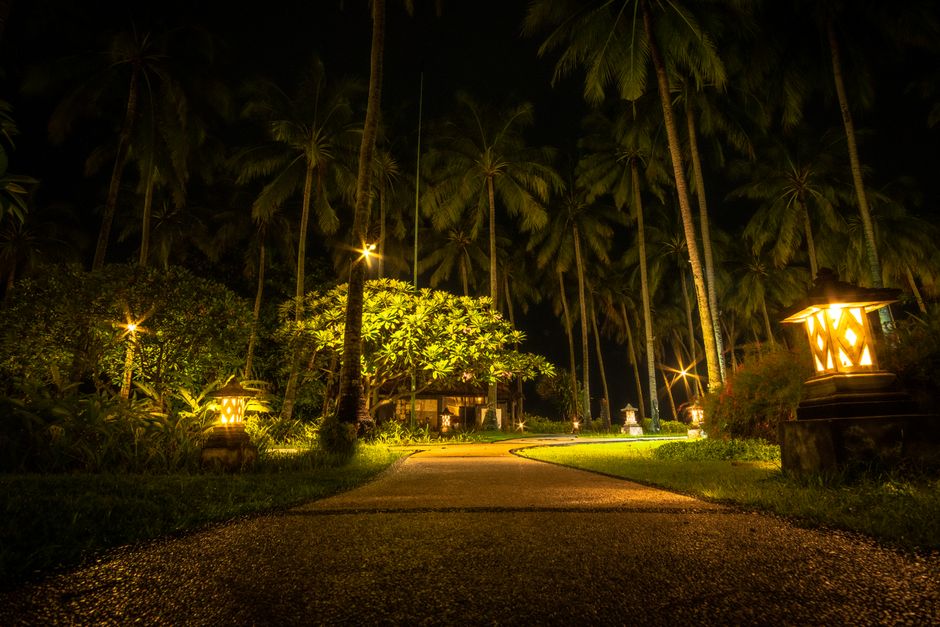
Beautiful landscape lighting ideas don’t have to drain your wallet or your energy meter. Today’s technology offers smart ways to create stunning effects while keeping an eye on both your budget and environmental impact.
Most homeowners are surprised to learn that a full-scale lighting project typically runs between $2,000 and $4,500, with higher-end solar or professional designs reaching $5,000 to $6,000. The good news? You don’t need to tackle everything at once. Many of our Twin Cities clients start with essential areas like entries and pathways before gradually expanding to accent and ambient lighting as their budget allows.
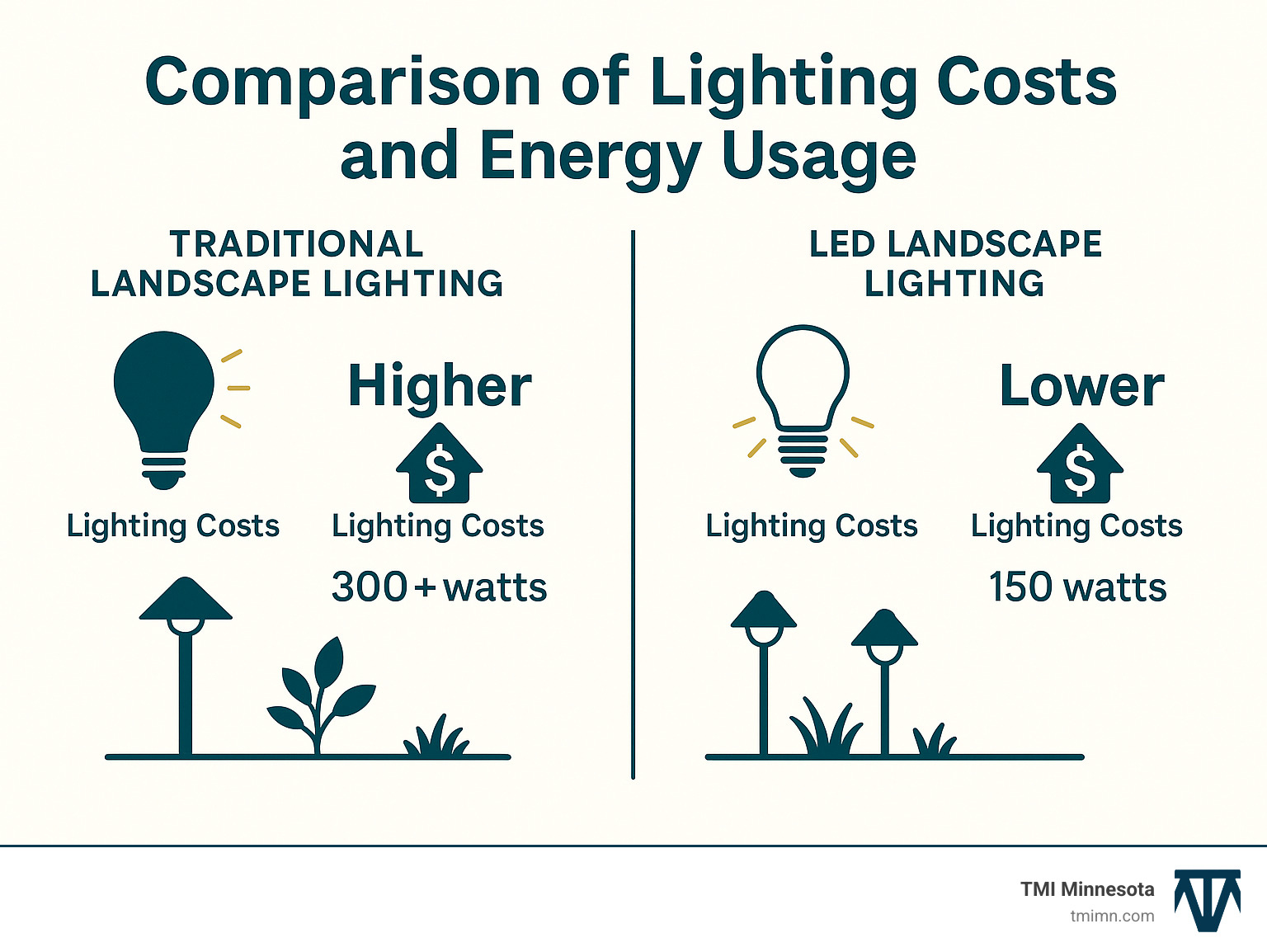
The LED revolution has completely transformed what’s possible in outdoor lighting. These tiny powerhouses consume a whopping 80-90% less energy than old-school incandescent or halogen bulbs, while lasting up to 40,000 hours—that’s over 13 years of nightly use! As one of our lighting specialists often tells clients, “LEDs sip electricity at just 1-11 watts versus the 20-60 watts that halogens guzzle.”
This efficiency adds up quickly. One delighted Edina homeowner couldn’t believe that their entire 51-fixture LED landscape system draws less power than three traditional light bulbs. At less than 200 watts total, their yard went from invisible to magical after dark without making their electricity meter spin like a top.
The materials you choose matter too, especially in Minnesota’s challenging climate. Solid brass, copper, and high-quality aluminum fixtures will withstand our freeze-thaw cycles and summer heat, while plastic-coated options tend to crack and warp after a few seasons. As we like to say, “Buy once, cry once”—quality fixtures might cost more initially but save money and frustration down the road.
It’s worth noting that as of August 1, 2023, the Department of Energy has officially banned non-conforming incandescent bulbs, making energy-efficient options like LEDs the new standard. This transition makes now the perfect time to upgrade any older landscape lighting systems.
Smart controls add both convenience and savings to your lighting system. Modern transformers equipped with astronomical timers automatically adjust to seasonal daylight changes, ensuring your lights activate precisely at dusk year-round. One busy Minnetonka executive told us this feature alone was worth the upgrade, eliminating the seasonal chore of reprogramming timers four times a year.
Scientific research on energy savings
More info about Backyard Change Services
Stretching Your Lighting Dollar
You don’t need an unlimited budget to create impressive landscape lighting ideas. With some strategic planning and smart choices, you can achieve professional-looking results while respecting your financial boundaries.
Low-voltage lighting kits provide an accessible starting point for the DIY-inclined. These kits typically include everything you need for a basic installation—transformer, cable, and several fixtures. While not as customizable as professional systems, they offer a solid foundation that you can build upon as your budget allows.
We often recommend a phased installation approach to clients concerned about upfront costs. For a young Plymouth family with growing children, we began with safety-focused lighting along pathways and entries, then added architectural and accent lighting the following year when their budget refreshed. This thoughtful staging gave them immediate benefits while working toward their complete vision.
When it comes to fixtures, I always remind clients that quality trumps quantity. Five strategically placed, high-quality fixtures create far more impact than a dozen cheap ones scattered randomly throughout your yard. Better fixtures not only look more impressive but typically last years longer, reducing frustration and replacement costs.
Energy efficiency directly impacts your bottom line month after month. While LED fixtures might cost more initially, they typically pay for themselves within three years through energy savings alone. For a recent Edina project, we calculated that switching from halogen to LED reduced the client’s lighting-related energy costs by almost 85%.
Transformer sizing offers another opportunity for cost optimization. Rather than installing multiple small transformers, we usually recommend a single larger unit with room for future expansion. This approach not only reduces equipment and installation costs but provides flexibility as your lighting needs evolve.
Don’t overlook warranties when comparing options. Quality manufacturers typically stand behind their products with 5-10 year guarantees on fixtures and transformers. One Wayzata client finded the value of this protection when a severe hailstorm damaged several fixtures—the comprehensive warranty saved them thousands in replacement costs.
Going Green & Connected
Today’s landscape lighting ideas can be both environmentally responsible and intelligently connected, giving you unprecedented control while minimizing your carbon footprint.
Solar-powered fixtures have come a long way in recent years. Modern solar lights feature improved photovoltaic cells paired with energy-efficient LEDs, offering reliable illumination even in Minnesota’s variable climate. When we designed lighting for a remote shoreline path at a White Bear Lake property, solar bollards provided the perfect solution where running electrical lines would have been prohibitively expensive and disruptive to the natural landscape.
The key to successful solar lighting is strategic placement. We recommend positioning solar fixtures where they’ll receive at least six hours of direct sunlight daily for optimal performance. While they’re not ideal for densely shaded areas, solar options shine in sunny locations where they can harvest maximum daylight.
Smart technology has completely transformed how we control outdoor lighting. Wi-Fi-enabled transformers now allow you to manage your entire lighting system from a smartphone app, adjusting timing, brightness, and even color in some systems. One tech-savvy Eden Prairie client loves showing off how they can change their entire yard lighting with voice commands through their home automation system.
Programmable schedules offer both convenience and energy savings that previous generations of lighting systems couldn’t match. Rather than keeping all lights on at full brightness from dusk to dawn, smart systems create lighting scenes for different times and purposes. A Wayzata family programmed their system to provide bright illumination during evening entertainment hours, automatically switching to subtle security lighting after midnight when everyone’s typically asleep.
Motion sensors add both security and efficiency to any landscape lighting plan. Strategically placed near entries and dark corners, these sensors provide illumination exactly when needed while conserving energy the rest of the time. For a Minnetonka installation, we integrated motion sensors with pathway lighting near the garage entrance, ensuring safe passage when returning home after dark without keeping lights on continuously.
Color-changing LED technology opens up creative possibilities for special occasions. While we generally recommend consistent warm white lighting for everyday use, programmable RGB fixtures allow homeowners to create festive displays for holidays or events. The delighted faces of neighborhood children when one Lake Minnetonka client changes their landscape lighting to themed colors for different holidays makes the additional investment worthwhile.
The integration of landscape lighting with broader home automation represents the cutting edge of outdoor technology. Your outdoor lighting can now be as intelligent as it is beautiful, responding to your needs, the weather, and even your daily routines without you lifting a finger.
Frequently Asked Questions about Landscape lighting ideas
How far apart should I space my path lights?
Finding that perfect spacing for path lights is both art and science. For standard low-voltage LED fixtures, we typically recommend 10-15 feet between lights. This creates those beautiful pools of light that guide visitors along your walkway without creating that airport runway look nobody wants.
If you’re going the solar route (which many of our eco-conscious Twin Cities clients do), you’ll want to place them a bit closer—about 6-8 feet apart. Solar fixtures generally don’t throw light quite as far, so they need a bit more help from their neighbors.
“I was placing my lights too close together,” one Edina homeowner told me. “Once I spaced them farther apart, my pathway suddenly looked like something from a magazine rather than a commercial airplane landing strip!”
For those winding garden paths that make Minnesota landscapes so charming, try alternating fixtures from side to side. We did this for a client in Minnetonka, placing lights that naturally followed the curves of their woodland path. The result was magical—like following breadcrumbs through an enchanted forest.
Wider paths might need more light coverage, while narrower ones can get by with fixtures spaced a bit farther apart. The goal is to create enough light to move safely while maintaining that warm, inviting atmosphere that makes your outdoor space special after dark.
Can I install landscape lighting myself?
Low-voltage landscape lighting is definitely one of the more DIY-friendly outdoor projects you can tackle. Since most systems run on just 12 volts (compared to the 120 volts in your home), they’re inherently safer to work with and don’t require deep burial of cables.
Many of our clients start with a simple kit that includes a transformer, some cable, and a few fixtures. These can work beautifully for basic pathway lighting or highlighting a few garden features. As one Maple Grove homeowner proudly told us, “I installed my first six path lights in a single afternoon, and they’ve been working perfectly for years.”
That said, there’s a noticeable difference between basic DIY installations and professionally designed systems. Understanding concepts like voltage drop (why fixtures at the end of your line might look dimmer), proper fixture selection, and optimal positioning takes some experience.
If you’re technically inclined and enjoy weekend projects, start with a simple area like a front walkway. Draw a plan first, invest in quality components (this is not the place to cut corners), and consider consulting with a professional for the design even if you handle the installation yourself.
For more complex projects—especially those involving water features, tree-mounted fixtures, or extensive layouts—professional installation often saves frustration and ensures optimal results. As one client in Eden Prairie admitted, “I thought I could do it all myself, but after struggling with uneven lighting and mysterious dimming issues, having a pro come in was worth every penny.”
How do I maintain fixtures year-round?
Minnesota’s dramatic seasons make landscape lighting maintenance particularly important. A little seasonal care keeps your system looking brilliant year after year.
Twice-yearly lens cleaning makes a surprising difference in light output. Clean lenses deliver up to 30% more light than dirty ones. We recommend a quick wipe-down in spring and fall using just a soft cloth and mild soap to remove pollen, dirt, and those mineral deposits that can cloud your fixtures.
“I couldn’t figure out why my lighting seemed to be getting dimmer,” one Wayzata client told us. “Turns out a season’s worth of pollen and dust was blocking almost a third of the light! A quick cleaning made everything bright again.”
During your seasonal cleaning, take a moment to check those wiring connections, especially after winter when frost heave can stress cables. Look for exposed wires, loose connections, or signs that your neighborhood squirrels have been treating your electrical system as a snack.
LED bulbs rarely need replacement—they typically last 7-15 years of nightly use—but when replacement is necessary, match both wattage and color temperature to keep your lighting effects consistent throughout your landscape.
Winter brings special challenges in Minnesota. Before the first snow, consider marking fixture locations with reflective stakes to prevent accidental damage from shovels or snow blowers. We’ve seen too many path lights meet an unfortunate end under an enthusiastic snow-clearing session!
Don’t forget to adjust your timers with the seasons unless you’ve invested in astronomical timers that automatically track sunset times. Your lighting schedule that worked perfectly in December will have your lights coming on in broad daylight by June.
Finally, landscapes grow and change. What was once perfect uplighting on a young maple might need adjustment as the tree matures. During your annual maintenance, take a moment to evaluate whether fixture positions need tweaking to accommodate your ever-changing outdoor canvas.
With proper care, a quality landscape lighting system can provide 15-20 years of reliable performance—making it one of the most durable investments in your outdoor living space.
Conclusion
Changing your Twin Cities property with landscape lighting ideas is one of the most rewarding investments you can make in your outdoor space. Good lighting doesn’t just illuminate—it extends your enjoyment of your yard well beyond sunset, creates a safer environment, and significantly boosts your home’s curb appeal and value.
Throughout this guide, we’ve seen how effective landscape lighting blends artistry with technical know-how. The creative elements—showcasing your home’s architecture, creating depth and visual interest, setting the perfect mood—work together with practical considerations like managing voltage, choosing the right fixtures, and maximizing energy efficiency.
Your lighting plan should be as unique as your property. The mature maple in your front yard, the winding path to your door, the cozy patio where you gather with friends—each deserves thoughtful illumination that complements your personal style and how you use your outdoor spaces. Whether you’re drawn to the gentle guidance of path lights or the dramatic impact of uplighting on your favorite tree, your lighting should tell your home’s story after dark.
At TMI Minnesota, we love creating custom lighting solutions that transform ordinary yards into extraordinary nighttime retreats. Our team brings both technical expertise and design sensitivity to every project, ensuring your landscape lighting remains beautiful and functional through all of Minnesota’s seasons.
Your landscape lighting can evolve over time. Many of our clients start with the essentials—illuminating pathways, entries, and main living areas—then gradually expand to accent lighting and special features as budget allows. This phased approach lets you spread the investment while immediately enjoying the benefits of a well-lit outdoor space.
The change that happens when dusk falls and your carefully planned lighting activates is truly magical. As one of our clients recently told us, “It’s like having two completely different yards—one for day and one for night—and I love them both.”
Ready to explore how landscape lighting ideas can transform your Twin Cities property? We’d love to walk your yard at dusk, point out opportunities, and help you find the possibilities that await when darkness falls.