
Changing Challenges into Opportunities: Sloped Garden Design
Slope garden ideas can transform challenging terrain into stunning outdoor spaces. Here are the key approaches to consider:
- Terracing – Creating level areas with retaining walls
- Meandering Pathways – Adding winding steps and walkways for access
- Strategic Planting – Using deep-rooted plants to prevent erosion
- Water Management – Incorporating drainage solutions like swales or French drains
- Multi-level Features – Installing decks, patios, or seating areas at different heights
A sloping garden offers unique advantages that flat landscapes simply can’t match – dramatic views, natural drainage, and the opportunity to create distinct garden “rooms” at different levels. Rather than viewing your slope as an obstacle, consider it a canvas for creative landscaping that adds dimension and character to your outdoor space.
Slopes present both challenges and opportunities. While erosion, accessibility, and maintenance require thoughtful planning, the rewards include improved views, natural division of space, and the chance to showcase plants from multiple angles. With the right approach, your sloped garden can become the most distinctive and beautiful feature of your property.
As Christopher Deanovic, Operations Leader at Task Masters, I’ve transformed countless challenging slopes into stunning, functional landscapes across Minnesota, applying innovative slope garden ideas that balance aesthetics with practical solutions for erosion control and accessibility.

Know your Slope garden ideas terms:
– Garden border ideas
– Hardscape design services
– Landscape lighting ideas
Slope garden ideas: Benefits, Challenges & First Steps
Getting started with a sloped garden begins with understanding what you’re working with. Here at TMI Minnesota, we always take time to conduct a thorough site survey before suggesting any slope garden ideas for your property.
Measuring your slope’s grade is our first priority. We use a zip-level tool (a water-level device that measures elevation differences) to determine exactly how steep your property is. This crucial measurement guides our approach:
- Gentle slopes (up to 15%): These are generally manageable with simpler landscaping techniques
- Moderate slopes (15-30%): Often require terracing or retaining walls for stability
- Steep slopes (over 30%): Need substantial structural support and careful professional planning

We also assess your soil type during our initial visit. Sandy soils drain quickly but tend to erode easily, while clay soils hold water but can become unstable when saturated. This information helps us determine the most effective stabilization methods for your unique situation.
During our assessment, we pay special attention to natural runoff paths. These water trails appear during rainstorms and show us where water naturally flows and where erosion control efforts should be concentrated. We always keep the 45° rule in mind: slopes steeper than 45 degrees (about 100% grade) almost always require professional engineering solutions for safety and stability.
Why a slope is an opportunity
What many homeowners see as a problem, we at TMI Minnesota view as a canvas full of possibilities! Your sloped yard offers unique advantages that flat landscapes simply can’t match.
Borrowed views are one of my favorite benefits of sloped gardens. Liftd positions let you “borrow” scenic vistas beyond your property line, making your garden feel more expansive. One client in Eden Prairie was amazed when our redesign revealed lake views they didn’t even know they had!
Natural drainage is another significant advantage. When properly managed, slopes provide excellent water movement, reducing the soggy spots that plague many flat gardens. This natural drainage can be channeled and used to create interesting water features or rain gardens.
Your slope might also create valuable heat sinks, especially if south-facing. These areas capture more solar energy, creating warmer microclimates that can extend your growing season by weeks on either end – a real bonus in our Minnesota climate.
Perhaps most exciting are the layered vistas that sloped gardens naturally create. Multiple viewing angles allow for dramatic, multi-dimensional planting designs that can be appreciated from various vantage points. As one Twin Cities client told us after we transformed their steep backyard: “What was once wasted space is now the most interesting part of our garden. We can see the whole design from our deck, like a living painting.”
Assessing your slope safely
Safety first! Before planning your slope garden ideas, we recommend conducting a simple erosion audit:
Look for warning signs like exposed plant roots, small landslides, or soil collecting at the bottom of your slope. Check for water damage patterns after heavy rains, and identify any visibly unstable areas that might need immediate attention.
For slopes over 30%, creating a basic contour map helps understand the topography. This doesn’t need to be complicated—even marking elevation changes every few feet with stakes can help visualize the terrain and plan effectively.
Very steep or large slopes benefit from professional assessment. Our team can evaluate structural integrity and potential hazards before planning begins. According to research from the Pacific Horticulture Society, slopes with proper stabilization can reduce erosion by up to 90% compared to bare slopes—a significant difference that protects both your property and local watersheds.
What seems like a challenging slope today could become the most distinctive and beautiful feature of your property tomorrow with the right slope garden ideas and professional guidance.
Stabilize & Drain: Erosion Control, Retaining & Terracing
Taming a slope starts with getting the ground to stay put. Before you can dream about that perfect hillside garden, you need to make sure your soil isn’t headed downhill with the next rainstorm. Trust me, I’ve seen beautiful plantings wash away overnight when the foundation wasn’t right!

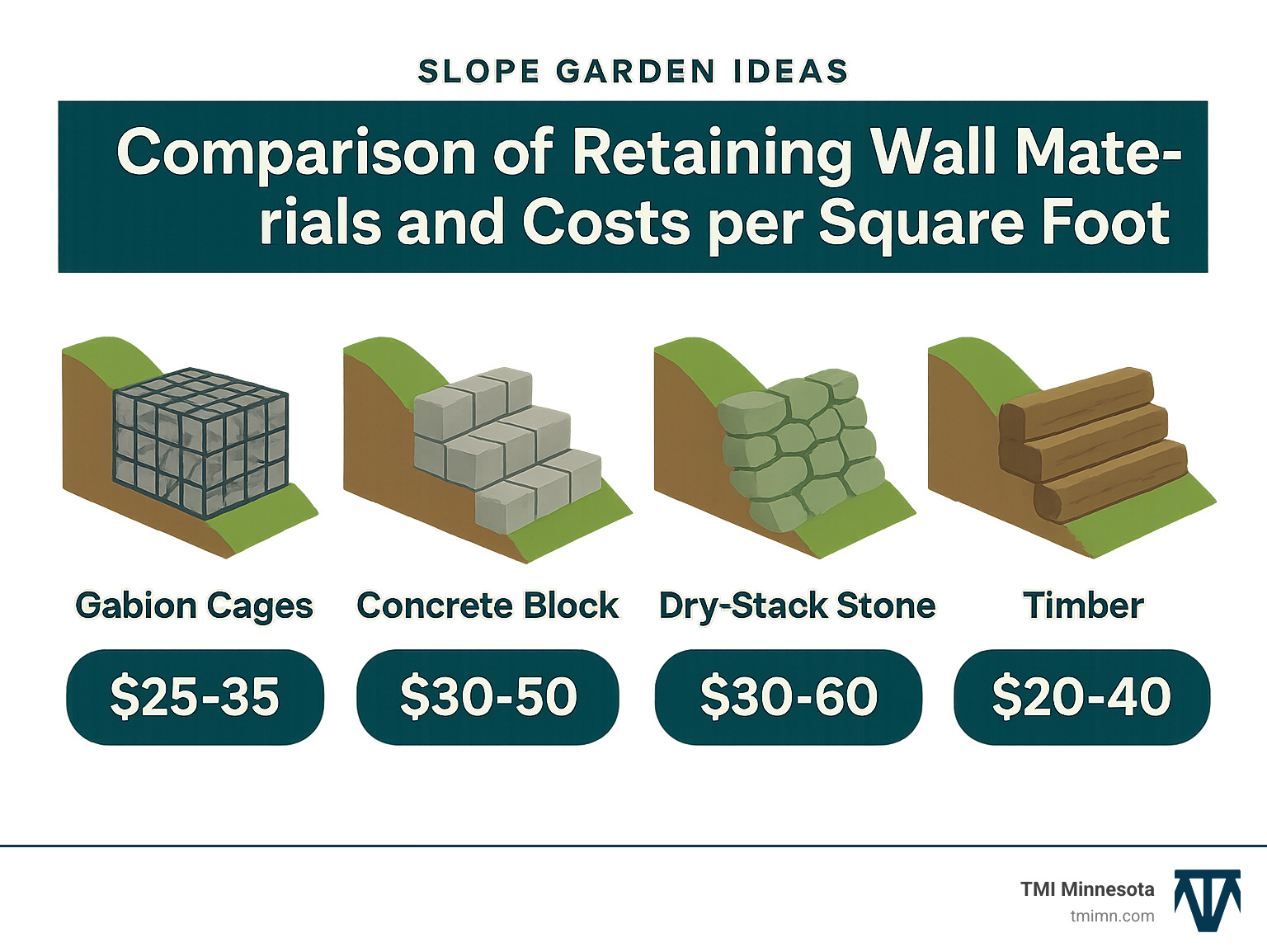
At TMI Minnesota, we’ve developed a toolbox of techniques that work wonders for slope stabilization. Timber sleeper tiers create charming, rustic terraces that won’t break the bank. For more permanent solutions, retaining walls made of stone, concrete, or block provide sturdy platforms for planting. I’m particularly fond of gabion cages – those wire baskets filled with stones – because they combine excellent drainage with a modern industrial look that many homeowners love.
When water management is a concern (and in Minnesota, when isn’t it?), we often install French drains beneath the surface to channel water safely away. For reinforcement that’s invisible but effective, geosynthetics – specialized fabrics and meshes – work beneath the soil surface to hold everything together. And don’t overlook the humble swale – these shallow, planted depressions slow water runoff naturally, giving it time to soak in rather than race downhill.
When to build a retaining wall
When your slope exceeds 50% grade (think of a black diamond ski run), it’s time to get serious about structural support. At this steepness, even the most aggressive root systems can’t hold soil in place during our famous Minnesota downpours.
We typically use the cut-and-fill method when building retaining walls. It’s a bit like Robin Hood – taking from the hill to give to the flat areas. We cut into the slope to create level ground, then use that excavated soil behind the wall. It’s efficient and reduces the need to truck soil in or out.
Here in the land of serious freeze-thaw cycles, proper footings aren’t optional – they’re essential. Your wall’s foundation needs to extend below the frost line (usually 42-60 inches deep in our region) to prevent the seasonal heaving that can turn a beautiful wall into a leaning tower. Our Retaining Wall Design Services ensure that your walls will stand strong through our challenging seasons.
A quick heads-up: retaining walls over 4 feet tall typically need an engineer’s approval and possibly a permit in most Twin Cities municipalities. Better to know this upfront than get that unwelcome visit from the building inspector!
Budget-friendly slope fixes
Not every hill requires a fortress wall. For gentler slopes and wallet-conscious homeowners, we’ve got several approaches that won’t require a second mortgage.
Pressure-treated sleepers create affordable terraces for slopes under 30%, typically costing $20-40 per linear foot installed. A Bloomington client told me they loved how these timber terraces “blended into the landscape instead of screaming ‘look at me!'”
Dry-stack stone offers excellent drainage and rustic charm for approximately $30-60 per square foot. The beauty of this approach is that each wall is unique – no cookie-cutter solutions here.
I’m a big fan of recycled hardcore – using broken concrete (“urbanite”) or reclaimed materials. It’s not just good for your budget (saving 40-60% compared to new materials), but it’s also good for the planet. One of my favorite projects involved using granite countertop cutoffs from a local fabricator to create a stunning modern wall that would have cost thousands more with new materials.
For DIY enthusiasts, consider a phased approach. Tackle your slope in sections over time, focusing first on the areas most at risk for erosion. Rome wasn’t built in a day, and your terraced paradise doesn’t need to be either.
Plant power for slope stability
Mother Nature has been preventing erosion for millions of years, and we can put her expertise to work in our slope garden ideas. Strategic planting can dramatically reduce the need for hardscaping on gentle to moderate slopes.
The secret is selecting plants with root systems that act like living rebar, binding soil particles together. Groundcovers like creeping phlox create dense mats that protect the soil surface while providing beautiful spring flowers. Drought-tolerant sedum varieties thrive on slopes (which naturally shed water) and require almost no maintenance. For something edible, wild strawberry offers both erosion control and sweet treats.
Ornamental grasses are slope superstars with their deep, fibrous root systems. Native prairie dropseed is perfectly adapted to Minnesota conditions and holds soil like a champ. Little bluestem offers gorgeous red-orange fall color along with its erosion-fighting abilities. Switchgrass can reach impressive heights while its roots extend just as far below ground.
For larger areas, native shrubs provide substantial erosion control. Sumac establishes quickly with spreading roots that grab onto soil. Various dogwood species adapt to different soil conditions while providing multi-season interest. Ninebark thrives in our climate and continues holding soil even during drought periods.
The science backs up what gardeners have known for generations – research shows that groundcover plants can reduce erosion by up to 90% compared to bare soil. Their intertwined root systems create a living infrastructure that holds tight even during our heaviest Minnesota thunderstorms.
For more plant suggestions custom to our challenging climate, explore our Drought Resistant Landscaping page. Many of these tough plants are perfect candidates for slope gardens, offering both stability and beauty with minimal water requirements. You might also find helpful information in this scientific research on groundcovers for hillsides and slopes.
Designing Levels & Zones for Living, Play & Produce
Once your slope is stabilized, the fun part begins—creating functional living spaces at different levels. A well-designed sloped garden naturally divides into distinct “rooms” or zones, each with its own purpose and character.

At TMI Minnesota, we’ve seen how a sloped yard can transform from a challenging headache into a multi-dimensional paradise. Think of your slope as nature’s way of giving you built-in room dividers! The natural topography creates perfect opportunities for different living spaces:
Upper levels capture those breathtaking panoramic views, making them ideal for dining areas and viewing decks where you can soak in the scenery while enjoying your morning coffee.
Mid-levels serve as perfect transitional spaces—imagine a cozy fire pit where friends gather on cool Minnesota evenings, intimate conversation nooks, or even playful zones where kids can explore.
Lower levels typically offer more space and protection, perfect for larger gatherings, productive vegetable gardens, or tranquil water features that become the focal point when viewed from above.
Slope garden ideas for outdoor rooms
Your sloped garden can host a variety of outdoor “rooms” that feel both connected and distinct. Here are some of our clients’ favorites:
A fire-pit terrace cut into the hillside creates a natural amphitheater feeling that practically begs for storytelling and s’mores. The slope itself becomes part of the seating arrangement, with custom benches that follow the natural contour of the land.
For food lovers, a dining patio anchored by retaining walls that double as built-in seating maximizes every inch of usable space. We carefully position these areas to capture sunset views or create easy access to your indoor kitchen—because nobody wants to carry the pasta salad up three flights of stairs!
One of our most requested features is a sunken lounge—slightly depressed seating areas that feel wonderfully intimate and protected. As one delighted Twin Cities homeowner told us, “It’s like sitting in a nest with a view. We feel both cozy and connected to the whole landscape.”
For properties with dramatic elevation changes, a viewing deck extending from the hillside creates a floating sensation that never fails to impress guests. These architectural features can be positioned to capture the golden light of sunrise or sunset, or to overlook water features that sparkle below.
I remember one family in Edina whose steeply sloped backyard sat unused for years. We transformed it into three distinct zones: an upper deck flowing from their kitchen for everyday meals, a mid-level fire pit area reached by a gently winding path, and a lower play zone where their children could run and explore. Now they use every inch of their property instead of just the flat spots near the house.
Steps, paths & accessibility
Connecting your garden levels requires thoughtful planning that balances beauty with practicality. Switchback paths that zigzag gradually up the slope are much easier to steer than straight climbs that leave you breathless (and not just from the beautiful views!).
For steeper sections, sleeper stairs crafted from landscape timbers offer an affordable, natural-looking solution that blends with the environment. When clients want something more permanent, we recommend concrete or natural stone steps with proper footings that won’t shift during Minnesota’s notorious freeze-thaw cycles.
Safety matters too. Building codes typically require handrails for stairs with more than three risers—especially important for ensuring grandparents and little ones can steer your garden with confidence. Our team always ensures installations meet local Twin Cities area codes.
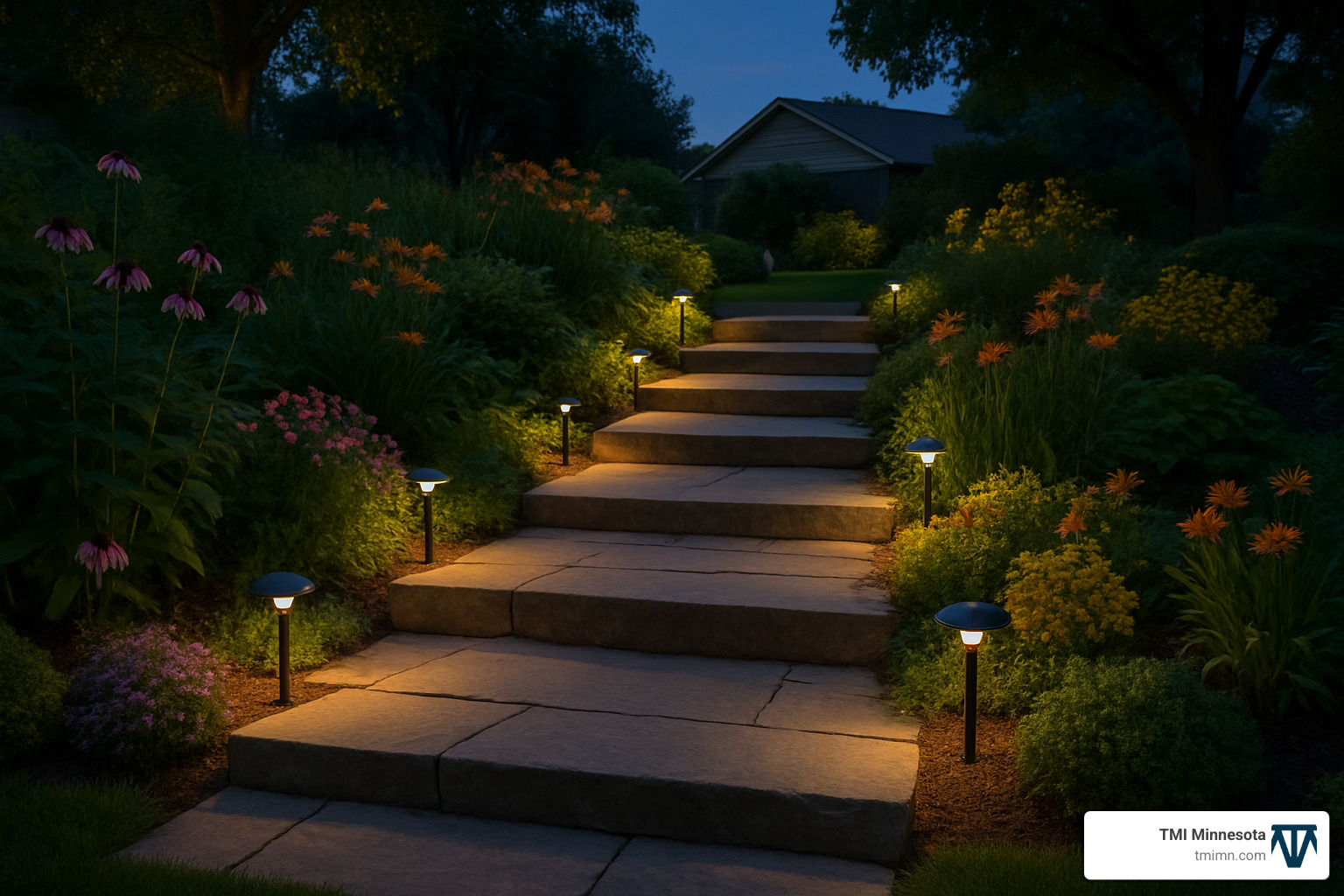
Don’t forget that your garden doesn’t end at sunset! Path lighting transforms your slope from a nighttime hazard into a magical evening landscape. Solar path lights offer an eco-friendly option, while low-voltage LED systems provide more reliable illumination during our long winter nights. Find more inspiration on our Garden Pathway Ideas page.
Here’s a professional tip we share with all our clients: When designing steps for a slope, consistency is key. We recommend a 6-inch rise with a 14-16 inch run for comfortable outdoor steps that feel natural to climb, even when you’re carrying a tray of lemonade.
Edible slopes & eco lawn alternatives
Why should your slope just look pretty when it could feed your family too? South-facing slopes receive more direct sunlight—making them perfect natural solar collectors for sun-loving vegetables and fruits.
We love installing raised veggie beds that run parallel to the contour lines and tilt slightly backward into the slope for stability. These raised areas warm up earlier in spring, potentially extending your growing season by precious weeks in our northern climate.
Drip irrigation becomes your best friend on slopes, where traditional sprinklers can cause runoff and erosion. These efficient systems deliver water exactly where plants need it, conserving both water and your energy bill.
Fruit shrubs and dwarf trees pull double duty on slopes—blueberries, raspberries, and compact apple trees provide delicious harvests while their root systems help hold your soil in place. One family in Minnetonka tells us their terraced berry garden produces enough for daily smoothies all summer long!
For Mediterranean flavor, herb terraces featuring rosemary, thyme, and lavender thrive in the well-drained conditions that slopes naturally provide. These plants evolved on hillsides, so they feel right at home on your slope.
Some areas might be too steep or awkward for traditional uses. That’s when eco-friendly lawn alternatives shine. Consider a clover lawn that stays drought-resistant while feeding pollinators, a native meadow mix that practically takes care of itself once established, or a carpet of creeping thyme that releases its wonderful scent with every step.
I’ll never forget the young couple who transformed their problematic north-facing slope into a terraced berry garden with strawberries, blueberries, and raspberries. Not only did the terraces make harvesting easier for their small children, but they created a beautiful cascading effect of colors and textures when viewed from their patio. What was once “that annoying hill” became the feature they’re most proud to show visitors.
Low-Maintenance Planting & Year-Round Interest
Let’s be honest—nobody wants to spend every weekend struggling up and down a slope with gardening tools. That’s the beauty of smart plant selection for sloped gardens—you can create a stunning landscape that practically takes care of itself.

Here in Minnesota, we’ve helped countless homeowners transform their challenging hillsides into low-maintenance showpieces. The secret? Choosing plants that multitask—stabilizing soil, suppressing weeds, and looking gorgeous through all four seasons without demanding constant attention.
Selecting plants that work while you relax
Think of your slope as nature’s display case—plants are viewed from multiple angles, creating a living mix that can be appreciated from above or below. But beauty shouldn’t mean backbreaking work.
Creeping phlox creates a breathtaking spring display, carpeting your slope with pink, purple, or white blooms that pollinators adore. Once established, it forms a dense mat that chokes out weeds and holds soil firmly in place—even during Minnesota’s heaviest spring downpours.
For summer-long color with practically zero maintenance, sedum varieties are slope superstars. ‘Dragon’s Blood’ offers rich burgundy foliage, while ‘Angelina’ brings brilliant golden tones. Their succulent nature means they thrive with minimal water, perfect for those hot, dry sections where irrigation is challenging.
When clients ask for truly bulletproof plants, we often recommend creeping juniper. These evergreen workhorses provide year-round coverage and serious erosion control. Their sprawling growth habit means one plant can eventually cover 6-8 feet of slope, saving you money and planting time.
For the middle layer of your slope garden, coneflowers earn their keep with months of blooms that attract butterflies and birds. Their deep taproots help anchor soil, and they’ll happily reseed themselves in just the right places. Pair them with black-eyed Susans for a prairie-inspired look that thrives in our Minnesota climate.
Russian sage deserves special mention for slopes that bake in the sun. Its silvery foliage and purple blooms create a dreamy, drought-resistant haze from midsummer through fall. Best of all, poor soil actually improves its performance—no fertilizing needed!
For structural anchoring, nothing beats our native prairie grasses. Not only do their extensive root systems prevent erosion better than almost anything else, but they also provide winter interest when most perennials have disappeared beneath the snow. Watching them sway in the breeze as they catch the low winter sun is pure Minnesota magic.
Proper mulching is your slope’s best friend. A 2-3 inch layer of shredded hardwood mulch will retain moisture and block weeds while staying put better than bark chips, which tend to wash downhill during heavy rains.
For truly hands-off watering, we recommend installing drip irrigation or soaker hoses along your slope’s contours. These deliver water directly to plant roots with minimal runoff—connect them to a timer and you’ve automated one of the most labor-intensive garden tasks.
Slope garden ideas for color in every season
A well-designed slope garden should never have an “off-season.” With thoughtful planning, your hillside can be the most interesting part of your landscape year-round.
Spring begins with early bulbs like crocus and daffodils planted in generous drifts. They emerge through a ground layer of sedums or creeping phlox for an effortless color explosion. Flowering shrubs like serviceberry add height and structure, with the bonus of edible berries later in the season.
For shadier slopes, spring ephemerals like bloodroot and Virginia bluebells create magical moments before trees leaf out fully. They perform their show, then politely retreat underground as summer plants take center stage.
Summer brings heat-loving perennials into their glory. Coreopsis offers cheerful yellow blooms that keep coming if you deadhead occasionally. Salvia and yarrow add spikes of blue and flat-topped clusters in shades from white to deep rose, creating textural contrast that’s visible from a distance.
By late summer, ornamental grasses reach their full height, creating movement and sound as they rustle in the breeze. Switchgrass, little bluestem, and prairie dropseed all offer different heights and textures while providing serious erosion control.
Fall transforms your slope into a canvas of warm colors. Native sumac blazes bright red, while viburnums offer deep burgundy tones. Late-blooming asters and goldenrod extend the flowering season when most gardens are winding down. The ornamental grasses you planted for summer height now develop beautiful seed heads that catch the light and later, the snow.
Winter reveals the importance of good “bones” in your slope garden. Evergreen framework provides structure when deciduous plants have dropped their leaves. Those ornamental grass seed heads become natural sculptures, especially beautiful when dusted with snow. Shrubs with colorful bark or persistent berries create focal points that draw the eye across your winter landscape.
For a truly spectacular spring display, consider adding masses of spring bulbs to your slope. You can find beautiful summer perennials to complement them from quality suppliers like Crocus.
By carefully selecting plants for sequential interest and varied textures, your slope becomes a dynamic, ever-changing landscape that practically maintains itself. The same challenging hillside that once gave you headaches can become the most admired feature of your property—with far less work than a traditional flat garden requires.
Safety, Lighting & Sustainability
A beautiful slope garden must also be safe, functional after dark, and environmentally responsible. At TMI Minnesota, we integrate these considerations from the earliest design stages.
Keeping family & visitors safe
Safety becomes even more critical when working with sloped terrain. I’ve seen too many beautiful hillside gardens that become treacherous obstacle courses after sunset or during Minnesota’s icy winters.
When designing steps and walkways, we focus on creating wide treads—at least 12 inches—to provide secure footing for everyone. Non-slip surfaces make a world of difference, whether that’s textured concrete or stone with naturally rough finishes. One client told me, “I used to avoid our backyard slope completely in winter, but now I actually enjoy taking the path down to fill the bird feeders, even after a light snow.”
Consistency matters tremendously with step design. We maintain riser heights between 6-7 inches throughout the entire pathway. This might seem like a small detail, but inconsistent step heights are actually the leading cause of stairway falls—your body expects each step to be the same as the last.
For steeper sections or anywhere with a significant drop-off, handrails aren’t just a nice addition—they’re essential safety features. We design these to complement your garden’s aesthetic while providing crucial support.
Surface selection plays a huge role in slope safety too. Materials with grip-enhancing textures like exposed aggregate concrete or textured pavers provide traction even when damp. We always incorporate proper drainage with a slight cross-slope of 1-2% on paths to prevent water pooling that could become treacherous ice in our Minnesota winters.
Lighting transforms a sloped garden from a nighttime hazard to a 24-hour feature. Motion-activated lights at transition points provide instant illumination when needed. Step lights recessed into risers create both safety and ambiance, while strategic path lighting guides movement through the landscape. For a comprehensive approach, check out our Softscaping and Hardscaping services that ensure all elements work together beautifully and safely.
For families with children or elderly members, we often incorporate low retaining walls along pathways that double as seating. These create natural rest spots while clearly defining edges—a subtle safety feature that improves rather than detracts from your garden’s beauty.
Sustainable slope solutions
Slope garden ideas offer unique opportunities for environmental stewardship that benefit both your property and the broader ecosystem.
Water management becomes a natural advantage with thoughtful slope design. Permeable paving allows rainwater to infiltrate the soil rather than rushing downhill, reducing erosion and replenishing groundwater. One of my favorite sustainable features is a well-designed dry creek bed—it channels water during heavy rains while creating a beautiful focal point during dry periods.
For properties with significant runoff, we often create rain gardens at the base of slopes. These slightly depressed areas filled with water-loving native plants capture, filter, and slowly release stormwater. One client’s rain garden not only solved their basement water issues but also became the most vibrant, colorful part of their landscape.
Rainwater harvesting systems work brilliantly on slopes, where gravity naturally directs water to collection points. This captured resource can then be used for irrigation during dry periods—a perfect example of working with nature rather than against it.
Slopes also provide excellent opportunities for habitat creation. By incorporating native plant communities at different levels, you create diverse ecosystems that support local wildlife. The vertical nature of slopes means you can showcase these plantings from multiple viewing angles, creating more visual impact with the same footprint.
Pollinator-friendly plantings thrive on slopes, where the excellent drainage suits many flowering natives perfectly. Strategic placement of rock piles and brush stacks provides shelter for beneficial creatures like native bees, small mammals, and birds. Undisturbed areas can serve as wildlife corridors, connecting different parts of your property or linking to nearby natural areas.
Resource conservation extends beyond plants to the infrastructure of your slope garden. Solar-powered lighting systems harness the sun’s energy (often more available on slopes than flat areas), while locally-sourced or recycled materials reduce the carbon footprint of hardscaping elements. Drought-tolerant plantings minimize water needs, and strategically placed composting areas can be discreetly integrated into the landscape design.
A recent Twin Cities project transformed a barren, eroding hillside into a thriving ecosystem with native prairie plants, a functional dry creek bed for stormwater management, and solar lighting throughout. The homeowners regularly send us photos of the birds, butterflies, and beneficial insects that have made their revitalized slope garden home—the ultimate measure of sustainable success.
Frequently Asked Questions about Sloped Gardens
What’s the most cost-effective way to landscape a slope?
Money matters when tackling a sloped garden! The most budget-friendly approach really depends on what you’re working with. For those gentler slopes (under 15%), Mother Nature offers the best bargain – strategic planting with erosion-fighting groundcovers and deep-rooted perennials will give you the most bang for your buck. We’ve seen amazing results with creeping juniper, vinca, and prairie grasses that grip the soil without gripping your wallet.
When dealing with those middle-of-the-road slopes (15-30%), we often recommend a hybrid approach. Combining smart plantings with simple timber sleeper terracing creates effective erosion control without breaking the bank. Pressure-treated lumber costs a fraction of stone or block walls but still does the job beautifully.
For those challenging steeper slopes, sometimes there’s no way around it – a proper retaining wall becomes necessary. While it might seem expensive upfront, it’s actually more cost-effective than repeatedly replacing plants and soil that wash away with every heavy rain. Many of our Twin Cities clients find success by breaking their project into phases, tackling the most urgent areas first and spreading the cost over several seasons.
I always tell homeowners that thoughtful planning is your best money-saving tool. At TMI Minnesota, we help you develop comprehensive slope garden ideas that can be implemented over time as your budget allows. One client saved nearly $3,000 by following our phased approach rather than trying to transform their entire hillside at once.
Do I always need a retaining wall on steep ground?
Not necessarily! While retaining walls are fantastic solutions, they aren’t always required. Several factors come into play:
Your slope’s steepness is the primary consideration – those exceeding 50% (roughly 45 degrees) almost always need structural support. Your soil type matters too; sandy or loose soils tend to slip away more easily and might need walls even on gentler inclines. Water flow patterns across your property can also dictate the need for walls regardless of slope percentage. And of course, if you’re dreaming of flat, usable space on a steep hill, walls become practically essential.
I’ve helped many Twin Cities homeowners explore creative alternatives to traditional retaining walls. Reinforced soil slopes use geotextiles paired with strategic planting to create stable, vegetated hillsides. Crib walls (those interlocking timber structures filled with soil and plants) offer natural-looking support. Living walls combine structural elements with integrated planting for beautiful, functional solutions. And sometimes, a series of smaller terraced beds works better than one massive structure.
Last summer, we helped a family in Edina stabilize their backyard slope using a combination of small timber terraces and native plantings, saving them thousands compared to the massive retaining wall they thought they needed. The right slope garden ideas for your property depend entirely on your specific conditions and goals.
How do I water plants on a slope without wasting water?
Watering slopes efficiently is both an art and a science! Without the right approach, you’ll watch your water (and money) run straight downhill instead of nourishing your plants.
Drip irrigation is hands-down the most efficient method for slopes. These systems deliver water directly to plant roots with minimal waste. For hillsides specifically, we recommend pressure-compensating drip emitters that provide consistent flow regardless of elevation changes – a game-changer for ensuring plants at the top of your slope get the same moisture as those at the bottom.
Soaker hoses offer another excellent option. We place these along the contour lines (running horizontally across the slope) and secure them with landscape pins to prevent them from sliding downhill. This provides slow, deep watering that has time to soak in rather than run off.
Creating small basin irrigation areas – essentially mini berms or depressions around individual plants – holds water long enough for proper absorption. This old-school technique still works beautifully, especially for larger specimen plants.
Don’t underestimate the power of mulching! A 2-3 inch layer significantly reduces evaporation and slows runoff. We’ve seen water retention improve by up to 70% on mulched slopes compared to bare soil.
Timing matters too – water early in the morning to minimize evaporation, and water deeply but infrequently to encourage plants to develop deep, drought-resistant root systems. For established native plants, you might need minimal supplemental irrigation after the first couple of years.
One of my favorite slope garden ideas we’ve implemented for several Minnesota clients is connecting rain barrels at the top of a slope to gravity-fed drip lines. This creates an almost self-watering system that uses collected rainwater – both eco-friendly and extremely effective!
Conclusion
Changing a sloping garden from a challenging landscape into a stunning, functional outdoor space isn’t just possible—it’s an opportunity to create something truly special. At TMI Minnesota, we’ve witnessed countless homeowners find how slope garden ideas can turn previously troublesome areas into the most captivating features of their property.
Your sloped garden journey begins with understanding what you have and envisioning what it could become. Rather than fighting against gravity, accept it! Those changes in elevation create natural opportunities for dramatic views, distinct garden rooms, and visual interest that flat landscapes simply can’t match.
Remember to start with proper assessment and stabilization—this foundation ensures everything that follows will stand the test of time (and Minnesota’s challenging weather). By working with your slope’s natural features rather than against them, you’ll save both money and headaches while creating something that feels like it belongs in your landscape.
Creating distinct zones at different levels allows your family to use the entire property, not just the flat parts. That fire pit terrace halfway up the slope might become your favorite gathering spot, while a lower-level vegetable garden catches the perfect amount of sun for growing tomatoes and peppers.

When selecting plants, look for varieties that pull double-duty—providing both erosion control and visual appeal. Those deep-rooted ornamental grasses aren’t just holding your soil in place; they’re also creating movement and seasonal interest as they catch the breeze and change colors throughout the year.
Safety and sustainability should be woven into your design from the beginning. Well-lit steps with proper handrails ensure your beautiful garden can be enjoyed safely by everyone, while thoughtful water management turns potential erosion problems into sustainable solutions.
Don’t feel pressured to complete everything at once. Many of our most successful projects have been implemented in phases over several years. This approach not only makes the project more financially manageable but also gives you time to learn what works best in your unique landscape.
The views, multi-dimensional planting opportunities, and natural division of space all contribute to a sloped garden with character and charm that’s uniquely yours. What once seemed like a liability becomes your property’s most distinctive asset—a garden that tells your story while solving practical problems.
Ready to turn your hillside into a showpiece? Reach out through our quick form at Contact our landscape team and let TMI Minnesota craft a custom slope solution for you. Our experienced designers and installers understand the unique challenges of Minnesota’s varied terrain, and we’re passionate about creating outdoor spaces that improve both your property and your everyday life.
Your slope isn’t a problem—it’s a canvas waiting for inspiration. Let’s create something beautiful together.