
The Smart Way to Water Your Landscape
Ever watched your water bill climb while your plants still look thirsty? You’re not alone. As a Minnesota homeowner, finding that perfect balance between a lush landscape and water conservation can feel like chasing a rainbow.
Landscape irrigation solutions are simply systems designed to give your outdoor spaces exactly the water they need—no more, no less. When you find the right approach, you’ll see healthier plants, lower water bills, and spend less time dragging hoses around your yard.
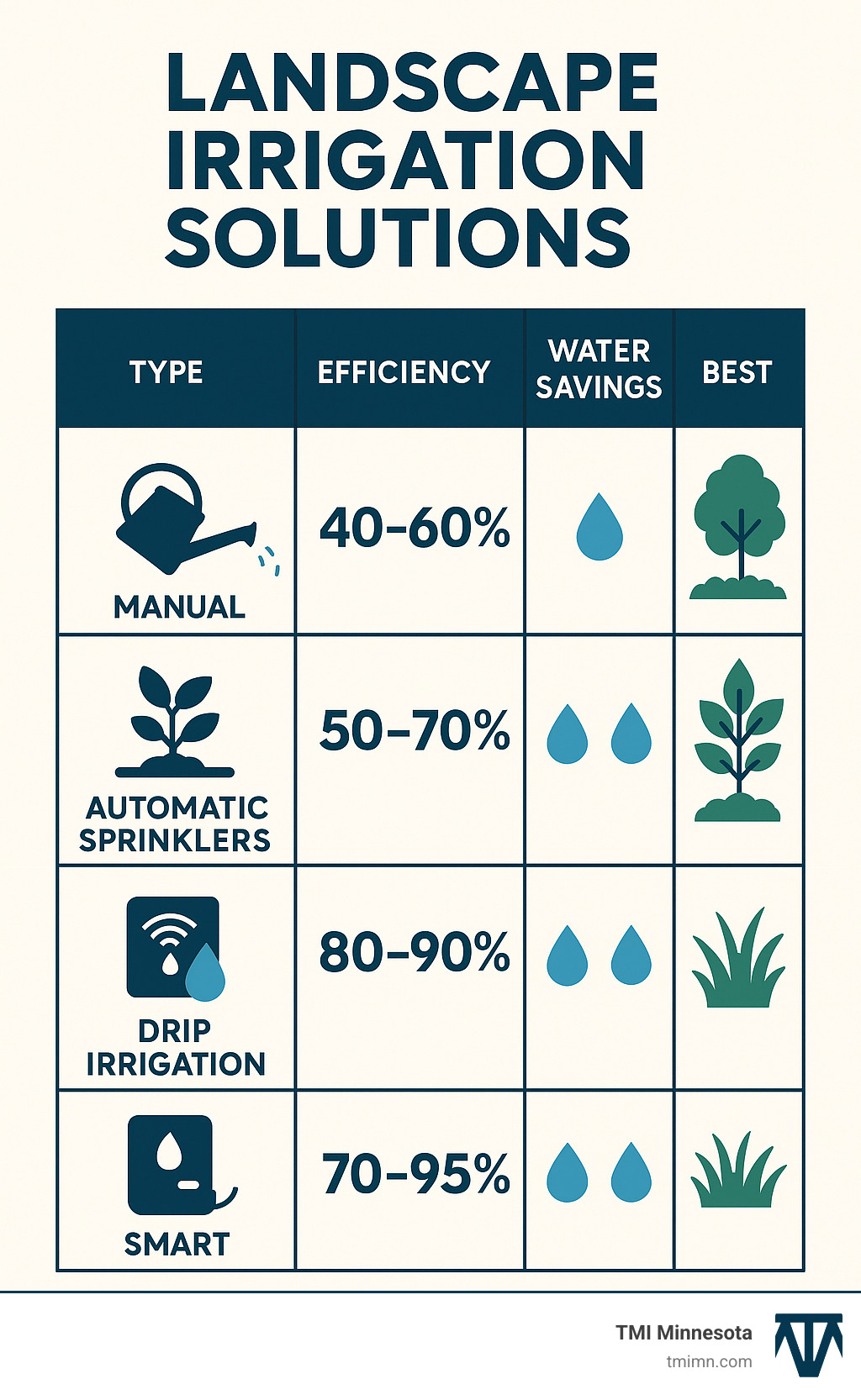
Let me walk you through your options. Manual systems like hoses and watering cans give you control but typically only achieve 40-60% efficiency. Automatic sprinklers offer convenience and bump that efficiency to 50-70%. If you’re serious about saving water, drip irrigation delivers moisture directly to plant roots with impressive 80-90% efficiency. For tech lovers, smart systems with weather-based controllers can reach 70-95% efficiency by adjusting to actual conditions. And for precision watering, micro-irrigation systems hit 85-90% efficiency with low-volume delivery.
Here’s a sobering thought: the average home irrigation system wastes about half the water it puts out. That’s literally money down the drain! But well-designed systems can achieve 75% efficiency or better, and adding smart controllers can slash water use by over 20%.
Creating a water-smart landscape isn’t just about being environmentally conscious—though that’s certainly a bonus. It’s about enjoying a gorgeous outdoor space that practically maintains itself. The right landscape irrigation solution matches your yard’s specific needs with technology that makes the most of every drop.
I’m Christopher Deanovic, Operations Leader at Task Masters. Over the years, I’ve helped countless Minnesota families transform their outdoor spaces with irrigation systems that work smarter, not harder. Nothing beats seeing a client’s face when they realize they can have that magazine-worthy landscape without the crushing water bills or constant maintenance.
If you’re thinking about upgrading your outdoor space, you might also want to explore our retaining wall design services, outdoor privacy solutions, or schedule a backyard design consultation to see how irrigation fits into your overall landscape vision.
Landscape Irrigation Solutions: Core Concepts
Let’s talk about watering your yard the smart way! Before jumping into specific systems, it helps to understand what makes irrigation work well. At its heart, landscape irrigation is simply giving your outdoor plants the water they need when rain isn’t enough.
Water Efficiency Basics
Good landscape irrigation solutions don’t just spray water everywhere—they deliver it efficiently. Think of it like this:
Imagine your yard as a neighborhood. Some residents (plants) are thirsty all the time, while others prefer things dry. Creating hydrozones means putting the water-lovers together so they can get what they need without drowning their drought-tolerant neighbors.
“The difference between a so-so irrigation system and a fantastic one isn’t just about buying fancy equipment—it’s about smart design,” explains our irrigation specialist at TMI Minnesota. “When we group similar plants and match how quickly water is applied to how quickly soil can absorb it, that’s when the magic happens.”
Your soil can only drink so fast—that’s where precipitation rate matters. Apply water too quickly and it runs off, wasting water and potentially causing erosion. Apply it evenly (uniformity) and slowly enough to soak in, and your plants will thank you with robust growth.
Manual vs. Automatic Systems
| Feature | Manual Systems | Automatic Systems |
|---|---|---|
| Initial Cost | $50-300 | $2,000-7,000+ |
| Water Efficiency | 40-60% | 50-95% (with smart tech) |
| Labor Required | High | Low |
| Precision | Low-Medium | Medium-High |
| Customization | Limited | Extensive |
| Best For | Small areas, budget constraints | Larger properties, busy homeowners |
While automatic systems cost more upfront, they typically pay for themselves through water savings and giving you your weekends back. That said, if you have a smaller space and don’t mind the exercise, a well-managed manual system can work beautifully.
How Landscape Irrigation Solutions Keep Plants Thriving
Have you ever noticed how some lawns look lush while others struggle, even with the same amount of water? The secret is often in how and where that water is applied.
Landscape irrigation solutions help your plants thrive by focusing on what matters most—the roots. When water reaches the root-zone directly, plants can actually use it. Spray water on leaves in the hot sun, and much of it evaporates before doing any good.
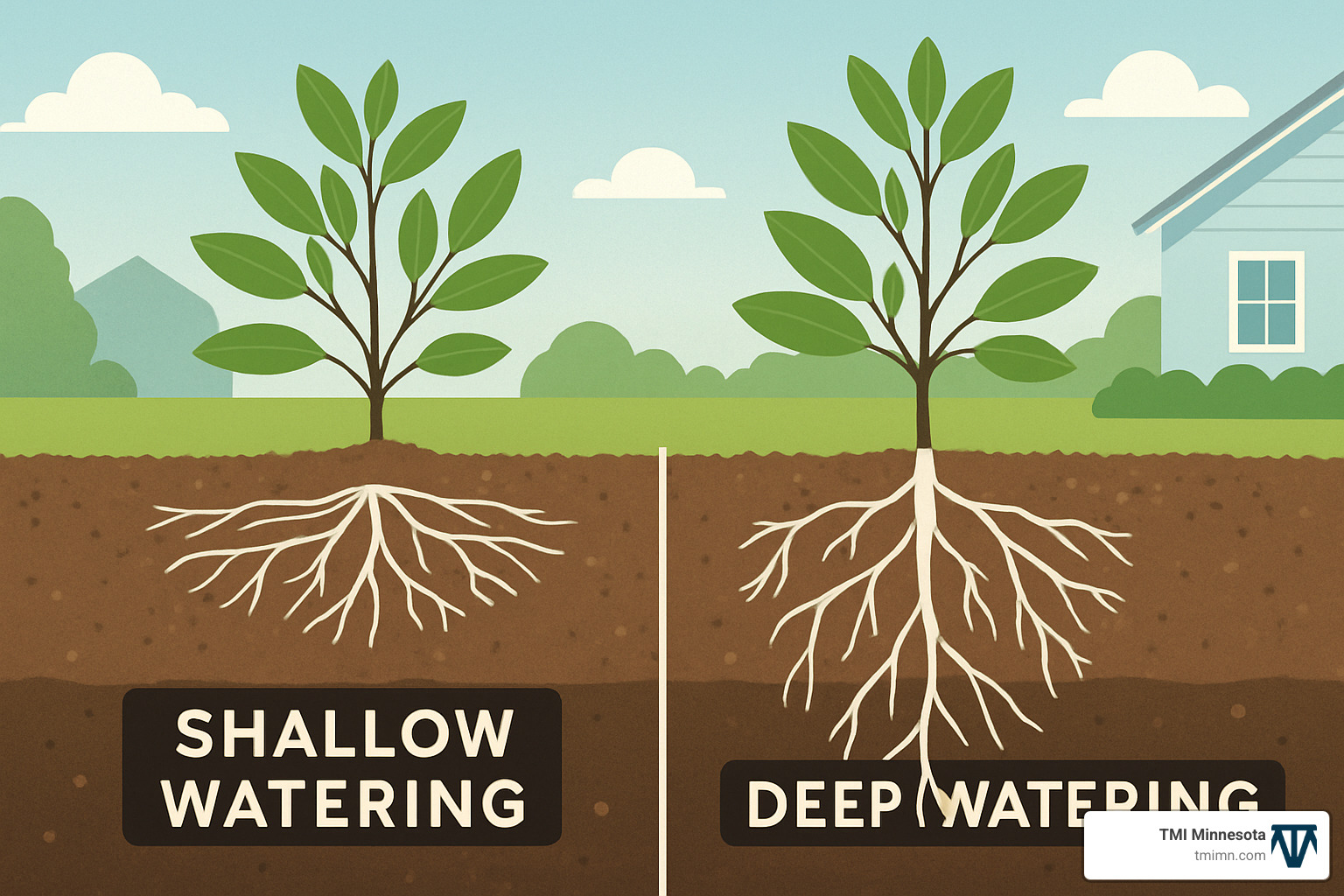
“We’ve seen amazing changes when clients switch from daily shallow watering to less frequent deep watering,” our TMI Minnesota landscape team often points out. “It’s like teaching plants to be self-sufficient. Their roots grow deeper, they become more drought-resistant, and they simply look healthier.”
Think of it as training your plants. Water deeply but less often, and roots will stretch downward seeking moisture. This creates stronger plants that can weather dry spells with grace.
Consistent moisture also prevents the stress cycle that makes plants vulnerable to pests and diseases. Plants that aren’t constantly swinging between drought and flood can focus their energy on growing beautiful flowers, fruits, or foliage rather than just surviving.
System Types at a Glance
The world of irrigation offers options for every yard and budget. Here’s what you should know:
Manual Systems are the simplest place to start. Your trusty garden hose connected to a sprinkler works for many situations. Soaker hoses offer an affordable step up, delivering water directly to soil with minimal evaporation. Add a simple hose-end timer, and you’ve got basic automation without the bigger investment.
Automatic Sprinkler Systems bring convenience and consistency. Spray heads work well for smaller areas, while rotors cover larger spaces efficiently. The star performers these days are rotary nozzles—they reduce water use by about 30% compared to traditional sprays by delivering water in multiple rotating streams that soak in better.
“The multi-stream rotary nozzles have been game-changers,” our irrigation team leader often tells clients. “They water more evenly and drastically cut waste—plus they’re less likely to mist away in the wind.”
Drip Irrigation is the efficiency champion, with water-saving rates of 80-90%. These systems deliver water drop by drop exactly where plants need it—at the root zone. Options range from emitter lines with pre-installed drippers to customizable systems where you place each dripper precisely where needed.
Subsurface Systems take efficiency even further by placing irrigation below ground. This virtually eliminates evaporation and can be ideal for lawns and established landscapes where you don’t want visible irrigation components.
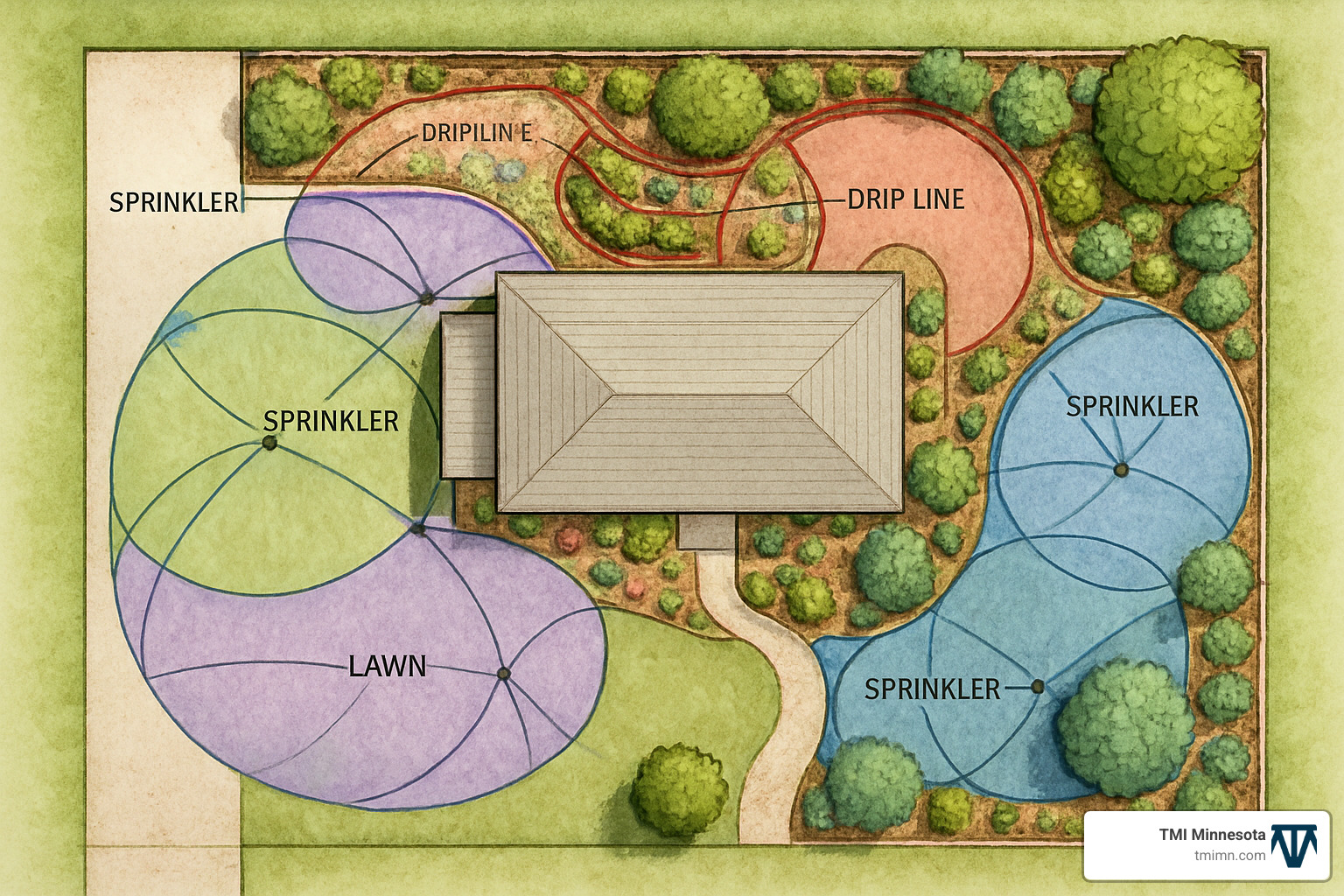
For most Minnesota homeowners, a thoughtful combination of these systems—perhaps rotary sprinklers for the lawn and drip for garden beds—provides the perfect balance of efficiency and plant health. And if you’re not sure which approach makes the most sense for your yard, we’re always happy to help you figure it out!
Selecting the Right System for Every Site
Choosing the appropriate landscape irrigation solution depends on multiple factors specific to your property. A thorough site assessment is the first step toward an efficient system.
Key Factors in System Selection
Minnesota’s unique climate presents special challenges for irrigation. During my years working with Twin Cities homeowners, I’ve seen how our hot summers and freezing winters demand adaptable systems. Your landscape irrigation solution needs to handle these extremes while still keeping your plants healthy.
The soil in your yard tells an important story about water needs. If you’ve got sandy soil, water drains through quickly—meaning you’ll need more frequent watering but in shorter bursts. Clay soil, which is common in many Minnesota neighborhoods, holds moisture longer but is prone to runoff. The ideal loamy soil offers that perfect middle ground of drainage and retention.
Your yard’s shape matters too. Those sloped areas in your backyard behave differently than flat spaces, causing water to move in ways that can either help or harm your landscape. And don’t forget about your water source—the available pressure and volume from your home’s system will determine what components will work best.
Many of our clients are surprised to learn about local watering restrictions. “Wait, I can only water on odd-numbered days?” is something we hear often. Yes, many Twin Cities municipalities limit watering, especially during summer months, so your system needs to maximize efficiency within these constraints.
Landscape Irrigation Solutions for Lawns & Turf Areas
Let’s face it—your lawn is probably the thirstiest part of your landscape. Getting this right makes a huge difference in both your water bill and how green your grass looks.
Rotary heads are our go-to recommendation for most Minnesota lawns. These rotating streams distribute water more slowly and evenly than traditional spray heads. The result? Water actually soaks in rather than running off into the street or driveway.
I love explaining matched precipitation rates to our clients because it’s such a simple concept with big benefits. Imagine trying to fill several cups with water using different sized hoses—some cups would overflow while others remain half empty. That’s what happens when your sprinklers apply water unevenly. Matching precipitation rates ensures every part of your lawn gets exactly what it needs.
The cycle and soak method is a game-changer, especially for those sloped areas or clay soils. Instead of watering for 15 minutes straight (and watching half of it run down the street), we break it into three 5-minute cycles with soak time in between. It’s like taking small sips of water rather than trying to drink the whole glass at once.
I remember working with a family in Edina whose water bill was astronomical. Their sprinklers were running off more water than they were putting into the soil! After switching to rotary nozzles and implementing cycle-soak programming, their lawn actually looked better while using 30% less water.
Beds, Trees & Shrubs: Precision Choices
Your beautiful perennial beds and prized maple trees have completely different water needs than your lawn. Why water them the same way?
Drip emitters are the precision tools of irrigation. They deliver water right to the root zone of individual plants—no waste, no evaporation, no wet leaves that can lead to disease. For a newly planted serviceberry, we might use a 2-gallon-per-hour emitter, while nearby perennials might get half-gallon emitters.
The ability to adjust emitters based on plant size and water needs is invaluable. I often tell clients to think about the difference between watering a tiny petunia and a 15-foot birch tree—they wouldn’t use the same amount from a watering can, so why would they from an irrigation system?
Soaker hoses are wonderfully simple solutions for densely planted beds. They quietly do their work at soil level, leaving foliage dry and weeds thirsty.
“A good drip system paired with proper mulching is like a dynamic duo for plant health,” I often tell our TMI Minnesota clients. A nice 2-3 inch layer of mulch around plants not only looks attractive but helps retain moisture, suppresses weeds, and protects those drip components from harsh UV damage.
For more information about our plant selection and bed preparation, visit our Softscape Services page.
Slopes, Hardscapes & Challenging Sites
Some of the most beautiful Minnesota landscapes include challenging elements that require special irrigation consideration.
Erosion control starts with smart watering. I’ve seen too many slopes where traditional sprinklers create mini-rivers after each watering cycle. What a waste! Not only does this lose precious water, but it can also wash away soil and damage your landscape over time.
For those tricky sloped areas, we typically recommend subsurface drip lines installed along the contours of the hill. These hidden heroes deliver water slowly and directly to the roots, eliminating runoff entirely. We also use pressure-compensating emitters that deliver the same flow at the top of the hill as at the bottom—something conventional systems simply can’t manage.
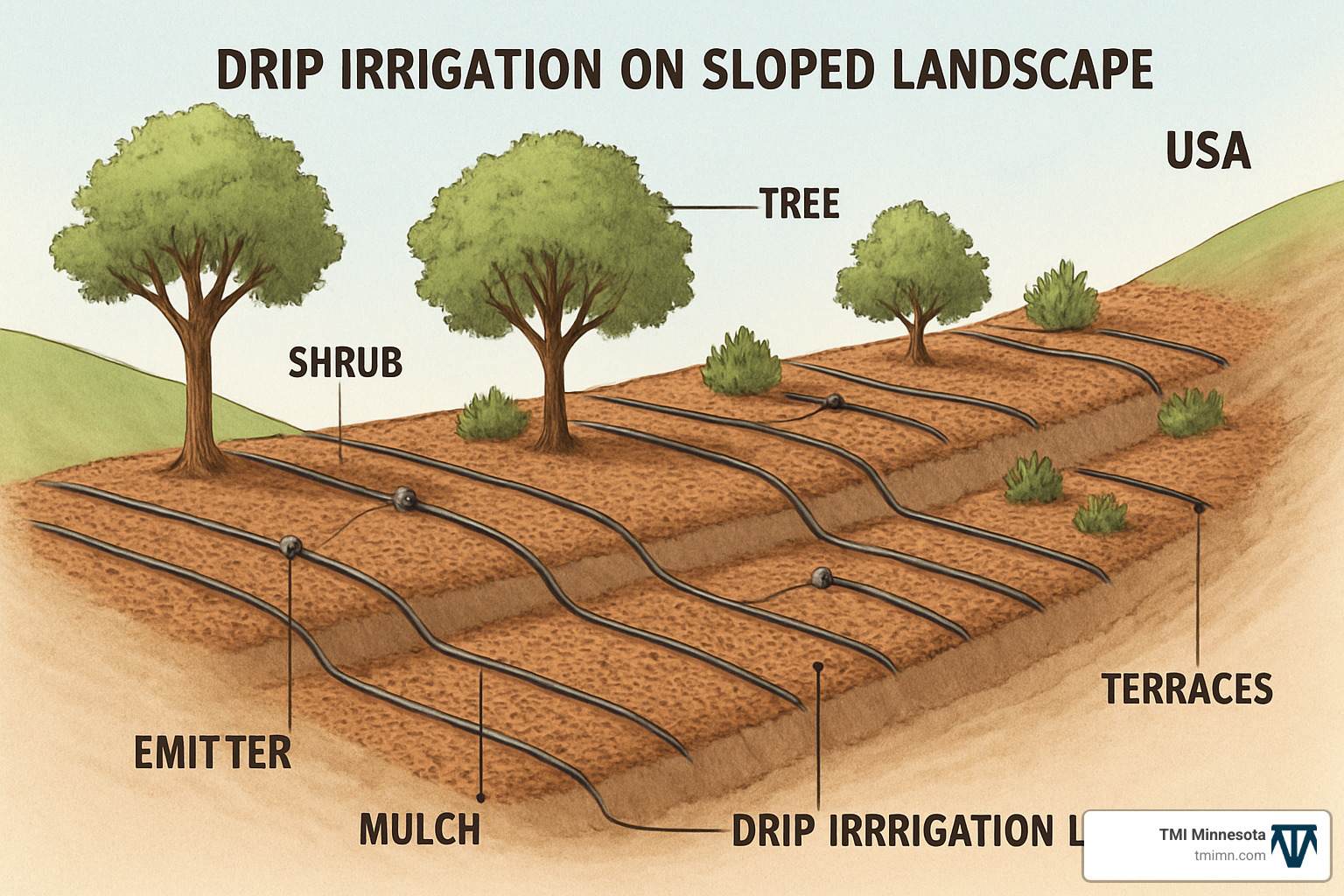
I love sharing the story of our Minnetonka client with that dramatic 45-degree slope in their backyard. It was a water-wasting nightmare before we transformed it with a terraced garden design and pressure-compensating drip lines. Not only did we solve the runoff problem, but we created a stunning visual feature that became the centerpiece of their outdoor space.
When it comes to hardscapes, precision is everything. Nobody wants sprinklers spraying their beautiful new patio furniture or creating slippery walkways. We use pop-up sprays with specialized patterns that provide exact edge watering without waste.
For clients concerned about water restrictions, we recommend a combination of smart technologies: rain sensors that prevent irrigation after a good rainfall, soil moisture sensors that activate watering only when truly needed, and even rainwater harvesting systems for those wanting to maximize sustainability.
These thoughtful approaches to challenging sites don’t just save water—they create healthier, more beautiful landscapes that thrive year after year in our unique Minnesota climate.
Smart Innovations & Emerging Technologies
The world of watering your yard has come a long way from dragging hoses around! Today’s landscape irrigation solutions combine cutting-edge technology with water-saving science to create systems that practically think for themselves.
Weather-Based Smart Controllers
Remember when sprinklers would run during rainstorms? Those days are gone thanks to ET (evapotranspiration) controllers that act like weather-watching gardeners:
“Smart controllers have revolutionized irrigation efficiency,” explains our irrigation specialist with a smile. “We’ve seen clients cut their water bills by 30-40% after upgrading to weather-based systems, while their landscapes actually look better than before.”
These clever devices connect to local weather stations or use on-site sensors to calculate exactly how thirsty your plants are based on temperature, humidity, sunshine, and wind. They then automatically adjust watering times to match—no more guesswork or wasted water! Studies show they can reduce water usage by more than 20% compared to traditional timers.
Soil Moisture Sensors
Why water on a schedule when you can water based on actual need? That’s the simple genius behind soil moisture sensors:
These smart little devices measure moisture right at the root zone where it matters most. Your system waters only when the soil actually needs it, not just because it’s Tuesday. You can even set different moisture thresholds for different areas—keeping your water-loving hostas happy without drowning your drought-tolerant sedum.
The result? No more soggy spots or crispy brown patches—just healthy plants using exactly the water they need.
Flow Sensors and Meters
Think of these as the watchdogs of your irrigation system:
Flow sensors monitor water moving through your pipes, alerting you to unusual patterns that might indicate a broken head or underground leak. Some can even automatically shut down the system if they detect a major problem, potentially saving thousands of gallons and preventing landscape damage.
Better yet, they provide useful data to help fine-tune your watering schedule over time. It’s like having a water efficiency expert constantly monitoring your yard.
Digital Mapping and Precision Application
The newest irrigation technology is almost like something from science fiction—systems that create digital maps of your exact landscape and then “print” water precisely where needed:
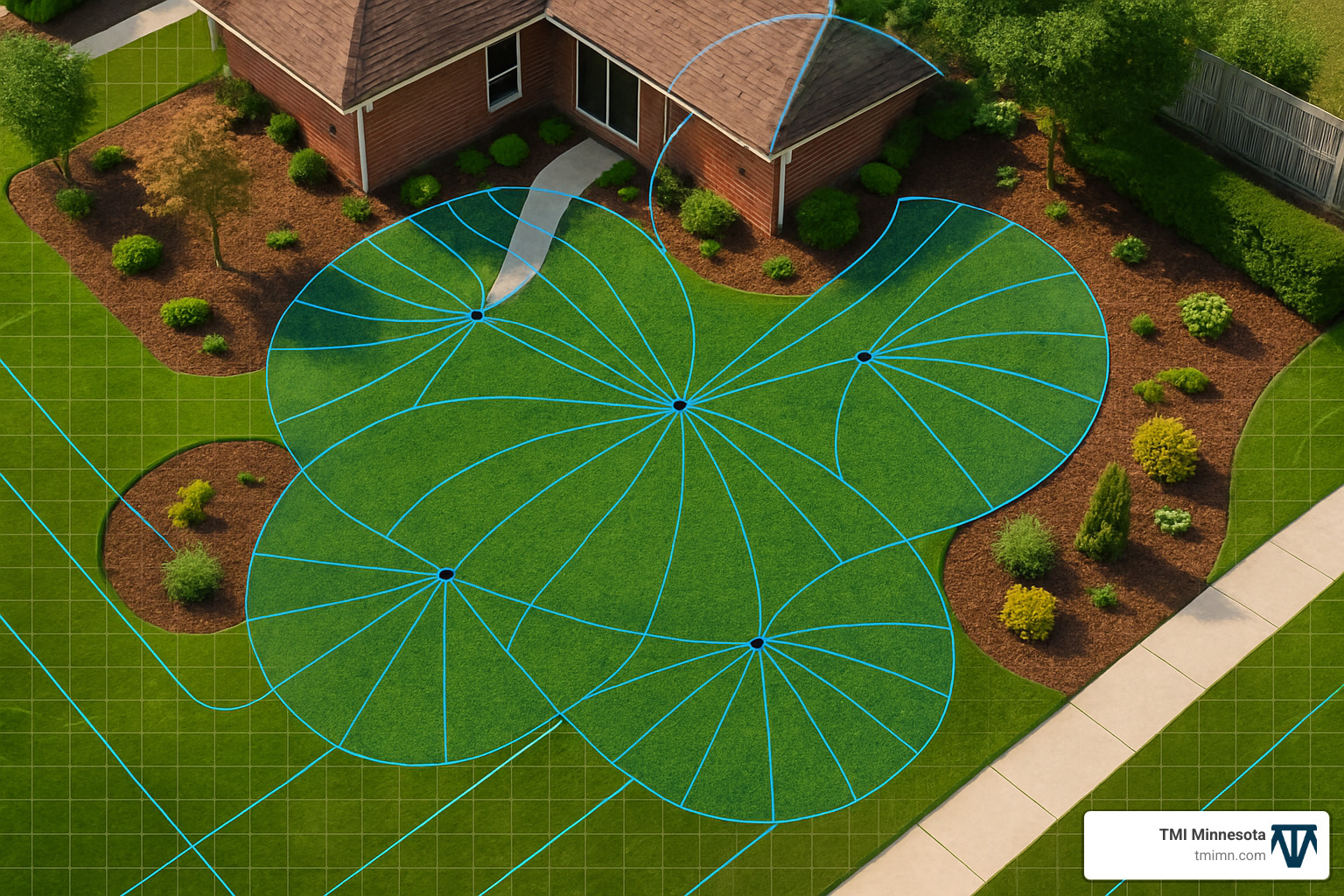
Instead of spraying in fixed patterns, these systems deliver water with incredible precision, eliminating waste on driveways and sidewalks. Early adopters report water savings up to 50% compared to traditional sprinklers—that’s real money back in your pocket while maintaining a beautiful landscape.
Landscape Irrigation Solutions in the Digital Age
Modern landscape irrigation solutions now extend right to your smartphone, putting control literally at your fingertips:
Smartphone control means you can adjust watering schedules from your couch or while on vacation. Get alerts about system issues, view water usage reports, and make seasonal adjustments without ever having to squint at that controller box in your garage.
Zone analytics give you incredible insight into your landscape’s water use. You’ll see which areas need the most water, how different schedules affect plant health, and where you can make improvements.
“The data from these systems is invaluable,” explains our TMI Minnesota team leader. “We can see exactly how each zone responds to different watering patterns and fine-tune the system for maximum efficiency.”
For those who love diving into the research, check out Scientific research on smart controller savings for in-depth information about just how effective these systems can be.
And if you’re maintaining an existing system, our Detailed sprinkler maintenance guide can help you keep everything running smoothly through Minnesota’s challenging seasons.
Design, Installation, Scheduling & Maintenance
When it comes to landscape irrigation solutions, selecting quality components is just the beginning. The real magic happens in how these pieces come together in a thoughtful design, proper installation, and smart ongoing management.
Designing for Water Efficiency & Future Growth
I’ve seen countless irrigation systems fail simply because they weren’t designed with the big picture in mind. Good design starts with understanding your property’s unique characteristics.
Pressure testing is our first step at TMI Minnesota. It’s like checking your blood pressure—it tells us exactly what we’re working with. Too much pressure creates a fine mist that blows away before reaching your plants, while too little leaves you with dry spots and unhappy vegetation.
“I remember a client in Edina who couldn’t figure out why half her garden always looked stressed,” shares our design team leader. “Turns out her pipe sizing was completely inadequate for the distance the water needed to travel. Once we corrected that, her entire landscape transformed within weeks.”
We always follow the head-to-head principle when spacing sprinklers—each sprinkler should throw water all the way to the next sprinkler. This creates that perfect overlap for uniform coverage that keeps your lawn looking consistently lush.
What many homeowners don’t consider is how their landscape will change over time. That cute little maple sapling might eventually block sprinkler patterns, and most people add new garden beds as years pass. At TMI Minnesota, we design with growth in mind, creating systems flexible enough to adapt to your evolving outdoor space.
For comprehensive landscape renovations including irrigation system upgrades, check out our Landscape Renovation Services page.
Controller Programming & Irrigation Scheduling Best Practices
Even the most perfectly designed system can waste water if programmed poorly. Smart scheduling is where science meets art.
Start times matter more than you might think. In Minnesota, early morning (4-7am) typically works best because:
– Evaporation rates are lowest
– Wind is usually minimal
– Plants have all day to dry, reducing disease risk
– You’ll avoid competing with neighbors for water pressure
When setting run times, we consider your specific conditions. Sandy soils need shorter, more frequent watering since they drain quickly. Clay soils need slower application to prevent runoff. The root depth of your plants is another crucial factor—established trees need deep, infrequent watering while new grass seed needs frequent light moisture.
Cycle and soak programming has saved countless gallons of water for our clients, especially those with sloped properties. Instead of running a zone for 15 minutes straight (watching half the water run down the street), we might program three 5-minute cycles with 30-minute breaks between. The water has time to soak in, reaching roots instead of storm drains.
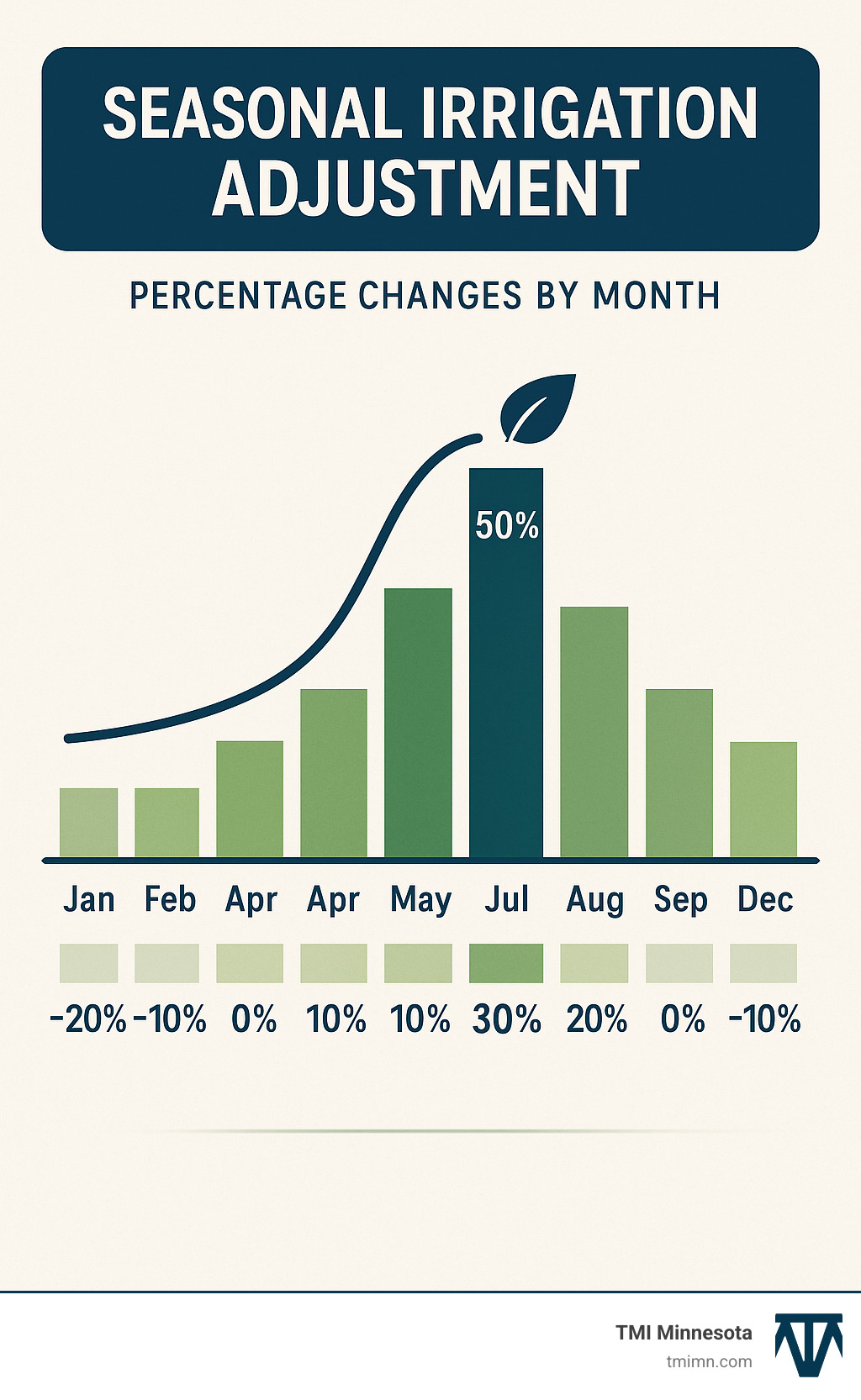
Minnesota’s dramatic seasonal changes demand regular adjustments to your watering schedule. A good rule of thumb: your lawn needs about 1 inch of water weekly in summer, but significantly less in spring and fall.
Maintenance & Troubleshooting 101
Even the Cadillac of irrigation systems needs regular TLC to keep performing at its best.
During growing season, I recommend a quick monthly check of your system. Simply run each zone for a few minutes and walk the area. You’ll be surprised what you might spot—a head that’s been decapitated by the lawn mower, a nozzle clogged with debris, or a head that’s settled and now waters more sidewalk than landscape.
“The most common issue we see is misaligned heads,” notes our maintenance team. “It happens gradually, often from settling soil or physical impacts, and homeowners don’t notice until their water bill spikes or brown patches appear.”
For drip irrigation, clogged emitters are the usual culprit when plants start looking thirsty. Regular flushing of the system helps, as does occasional cleaning of individual emitters.
Controller problems typically show up as either zones not running at all or running at unexpected times. Check for simple issues first—dead batteries in older controllers, power outages that reset programming, or seasonal adjustment settings that may have been changed.
If you’re in Minnesota, winterization isn’t optional—it’s essential. Our freeze-thaw cycles are particularly hard on irrigation systems. Properly blowing out all water from your lines before the first hard freeze can save you thousands in repairs come spring.
“One client skipped winterization to save a few bucks,” our technician recalls. “The following spring, they ended up replacing nearly every valve and dozens of broken pipes. That $150 winterization service would have been a bargain in comparison.”
For seasonal maintenance or system upgrades, TMI Minnesota offers comprehensive services to keep your irrigation running efficiently year after year, protecting both your landscape investment and our precious water resources.
Frequently Asked Questions about Landscape Irrigation Solutions
How often should I run my system?
Figuring out the perfect watering schedule is a bit like finding the sweet spot on your toaster – it depends on what you’re working with! Several factors influence how frequently you should water:
Soil type makes a huge difference. Sandy soil drains quickly, so it needs more frequent watering. Clay soil, on the other hand, holds moisture longer but can become waterlogged if you overdo it.
Plant type matters too. Those native Minnesota plants that have adapted to our climate need far less babying than thirsty annuals or new transplants. Your established oak tree and your new impatiens have completely different needs!
Season and weather are obvious factors – hot July days demand more water than cool September evenings. And don’t forget about sun exposure – that south-facing bed baking in the afternoon sun will dry out much faster than areas in partial shade.
Here in the Twin Cities during summer, a good starting point for lawns is:
– Clay soils: Deep watering 1-2 times weekly
– Loam soils: 2-3 times weekly
– Sandy soils: 3-4 times weekly
“The finger test is still one of the most reliable methods,” our irrigation specialist often tells clients. “Just insert your finger into the soil up to the second knuckle. If it feels dry at that depth, it’s time to water.”
The goal is developing deeper root systems, not just keeping the surface moist. Watering deeply but less frequently encourages roots to grow downward, creating more drought-resistant plants that require less maintenance over time.
What makes drip irrigation so water-wise?
Drip irrigation is the efficiency champion of the watering world, achieving an impressive 80-90% efficiency compared to sprinklers’ modest 50-70%. It’s like the difference between pouring water directly into a glass versus tossing it from across the room!
This remarkable efficiency comes from targeted delivery – water goes straight to plant roots instead of spraying everywhere. Since water isn’t traveling through the air, there’s dramatically reduced evaporation, especially on hot, windy days when sprinklers can lose up to 30% of water before it even hits the ground.
The slow, steady application also means virtually no runoff, allowing water to soak in rather than stream across the surface. As an added bonus, areas between plants stay relatively dry, which means fewer weeds competing with your desirable plants.
“We installed drip irrigation for a client with extensive perennial beds,” our landscape team recently shared. “Not only did their water usage drop by 60%, but plant health improved dramatically because the foliage stayed dry, reducing fungal issues.”
This last point is often overlooked – by keeping leaves and stems dry, drip irrigation helps prevent many common plant diseases that thrive in moist conditions. It’s a win for your plants, your water bill, and the environment!
How do smart sensors cut my water bill?
Smart sensors are like having a vigilant gardener constantly monitoring your landscape, except they never need coffee breaks or days off! These devices prevent unnecessary watering, which directly translates to lower water bills.
Rain sensors are the simplest option, automatically suspending your irrigation schedule when it’s raining or has recently rained. These affordable devices (typically $25-$100) can save thousands of gallons annually by preventing that all-too-common scenario of sprinklers running during a downpour.
Soil moisture sensors take things to the next level by measuring actual moisture at the root zone. Rather than watering on a fixed schedule regardless of conditions, these sensors only trigger irrigation when plants truly need it. The result? Water use reductions of 20-50% compared to timer-based systems.
Flow sensors act as an early warning system for leaks or broken components. They monitor water movement through your irrigation system and can detect unusual patterns.
One of our Twin Cities clients experienced this benefit firsthand: “They had a broken sprinkler head that went unnoticed for weeks, wasting hundreds of gallons daily. After we installed a smart controller with flow sensing, a similar break was detected and shut down automatically within minutes, saving both water and preventing landscape damage.”
The beauty of these smart landscape irrigation solutions is that they often pay for themselves quickly through water savings while simultaneously improving plant health. It’s rare to find upgrades that save money, reduce maintenance, and improve results – but smart irrigation sensors manage this trifecta beautifully!
Conclusion
The journey to a thriving landscape doesn’t have to come with a hefty water bill or endless maintenance. By implementing effective landscape irrigation solutions, you’re making one of the smartest investments possible for your outdoor space.
Throughout this guide, we’ve seen how irrigation has evolved from simple hoses and sprinklers to sophisticated systems that seem almost intuitive in their ability to deliver water exactly when and where it’s needed. Gone are the days of “set it and forget it” timers that run during rainstorms!
At TMI Minnesota, we’ve helped countless Twin Cities homeowners transform their outdoor spaces with irrigation systems custom to their unique needs. Whether you’re starting from scratch or upgrading an existing system, our team loves guiding you through the options without the technical jargon or sales pressure.
Remember these five golden rules of smart irrigation:
- Match the method to your landscape – Your sloped perennial bed needs something different than your flat lawn area
- Efficiency isn’t just environmental – Systems operating at 75%+ efficiency translate directly to lower water bills
- Smart technology actually pays for itself – Those weather sensors and moisture monitors can cut water use by up to half
- Regular check-ups prevent headaches – Just like your car, your irrigation system needs seasonal attention
- Professional design is worth every penny – Expert planning ensures your system performs beautifully for years
I’ve personally seen the difference proper irrigation makes in our Minnesota landscapes. Not just in water savings, but in how plants flourish when they receive consistent, appropriate moisture. The colors are more vibrant, the growth more robust, and the maintenance headaches significantly reduced.
For beautiful examples of how we integrate efficient irrigation with stunning landscape design, browse our Hardscape Gallery. You’ll notice how healthy plants complement the hardscape features, creating outdoor spaces that truly feel like an extension of home.
Water is precious, and using it wisely doesn’t mean sacrificing the landscape of your dreams. With thoughtful design, modern technology, and proper maintenance, your irrigation system can help create that lush, healthy outdoor space while being kind to both the environment and your wallet.